


- By ajith
- 13 Apr 2026
- No Comments
6061 Aluminum vs. 7075 Aluminum: Which Alloy Is Right for Your Application?
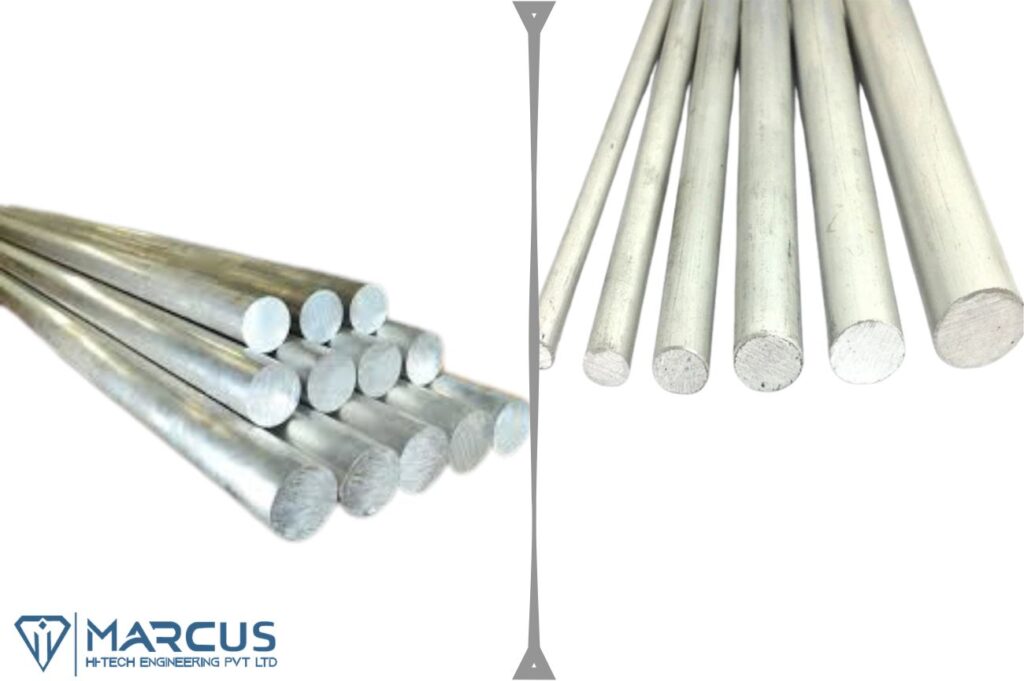
When engineers and designers specify aluminum for a component, the conversation almost always comes down to two alloys — 6061 and 7075. Both are widely used across automotive, aerospace, motorsport, and industrial manufacturing. Both machine well, offer good corrosion resistance, and deliver the strength-to-weight ratio that makes aluminum the material of choice across so many demanding applications.
But they are not the same alloy, and choosing the wrong one for your application can mean underperforming parts, unnecessary cost, or machining challenges that slow your production down.
This guide breaks down everything you need to know about 6061 and 7075 aluminum — composition, mechanical properties, machinability, corrosion resistance, cost, and real-world applications — so you can make the right material decision before a single part is cut.
What Is 6061 Aluminum?
6061 aluminum is the most widely used aluminum alloy in the world. It belongs to the 6000 series, which uses magnesium and silicon as its primary alloying elements. First developed in 1935, 6061 has become the go-to general-purpose aluminum alloy across virtually every manufacturing industry because it strikes the ideal balance between strength, machinability, weldability, corrosion resistance, and cost.
6061 is available in a range of tempers, with T6 being the most common in engineering applications. The T6 temper designation means the alloy has been solution heat-treated and artificially aged to achieve its peak mechanical properties.
What Is 7075 Aluminum?
7075 aluminum belongs to the 7000 series, which uses zinc as its primary alloying element along with magnesium and copper. It was developed in the 1940s and quickly became the standard high-strength aluminum alloy in aerospace and defense manufacturing — a position it still holds today.
7075 is significantly stronger than 6061, with tensile strength approaching that of many steel alloys, while still offering the weight advantage of aluminum. Like 6061, it is most commonly used in the T6 temper, though T73 is also widely specified where improved stress corrosion resistance is required.
Quality You Can Trust: IATF 16949 Certified
At Marcus Manufacturing, we don’t just “make” parts; we engineer them. We operate as an IATF 16949:2016 Certified Company. While this is a gold-standard automotive certification, we apply its strict rules for durability and traceability to every solar hanger we produce.
When you partner with us, you’re getting hardware that has been stress-tested for 400 kg loads and verified for material purity. With a legacy of being “Trusted since 1980,” we understand that in the energy sector, reliability isn’t optional—it’s everything.
Chemical Composition
The difference in performance between 6061 and 7075 starts at the chemical level.
- 6061 Aluminum: Contains silicon (0.40–0.80%), magnesium (0.80–1.20%), copper (0.15–0.40%), and chromium (0.04–0.35%). The magnesium and silicon combination forms magnesium silicide during heat treatment, which is responsible for the alloy’s strength and hardness.
- 7075 Aluminum: Contains zinc (5.1–6.1%), magnesium (2.1–2.9%), copper (1.2–2.0%), and chromium (0.18–0.28%). The high zinc content is what gives 7075 its exceptional strength. The copper content, while beneficial for strength, reduces corrosion resistance compared to 6061.
Mechanical Properties Comparison
This is where the two alloys diverge most significantly:
- Tensile Strength: 6061-T6 has an ultimate tensile strength of approximately 310 MPa (45,000 psi). 7075-T6 delivers approximately 572 MPa (83,000 psi) — nearly twice the strength of 6061.
- Yield Strength: 6061-T6 yields at approximately 276 MPa (40,000 psi), while 7075-T6 yields at approximately 503 MPa (73,000 psi).
- Fatigue Strength: 7075 outperforms 6061 in fatigue resistance, making it better suited for components subject to repeated cyclic loading like suspension arms or aerospace members.
- Hardness: 7075-T6 has a Brinell hardness of 150 HB compared to 95 HB for 6061-T6.
- Density: Both alloys have very similar density (6061 at 2.70 g/cm³ and 7075 at 2.81 g/cm³), meaning the strength advantage of 7075 comes with virtually no weight penalty.
Machinability
While both machine well compared to steel, there are meaningful differences:
- 6061: Widely regarded as one of the easiest aluminum alloys to machine. It produces clean chips, causes minimal tool wear, and allows for fast cutting speeds.
- 7075: Requires more attention to tooling and speeds. Its higher hardness generates more heat and causes greater tool wear than 6061, typically resulting in a slightly higher machining cost per part.
Weldability
- 6061: A clear winner here. It welds readily using MIG and TIG processes. It is widely used in welded structural assemblies and frames.
- 7075: Considered difficult to weld. Its high zinc and copper content make it susceptible to hot cracking. For 7075 assemblies, mechanical fastening or adhesive bonding are the preferred joining methods.
Corrosion Resistance
- 6061: Offers excellent corrosion resistance, performing well in marine environments and outdoor exposure.
- 7075: Has lower corrosion resistance due to its higher copper content. It can be susceptible to stress corrosion cracking in harsh environments.
Cost Comparison
- 6061: Significantly less expensive.
- 7075: Typically costs 20% to 40% more per kilogram than 6061. This reflects complex alloying and high demand from the aerospace sector. Machining 7075 also tends to be costlier due to tool wear.
Real-World Applications
- 6061 Aluminum: Automotive brackets, marine fittings, bicycle frames, consumer electronics enclosures, heat sinks, and architectural extrusions.
- 7075 Aluminum: Aircraft wing spars, high-performance motorsport suspension, competitive cycling components (handlebars/stems), firearms, and rock climbing hardware.
How to Choose Between 6061 and 7075
- Choose 6061 when: Your part requires good structural strength, weldability is important, corrosion resistance is a priority, or you are working within a tighter budget on high-volume runs.
- Choose 7075 when: Your application demands maximum tensile strength, the part is subject to high fatigue/cyclic loading, weight is absolutely critical, and the part will be mechanically fastened.
Marcus Manufacturing: Precision Machining in Both Alloys
At Marcus Manufacturing, we machine both 6061 and 7075 aluminum to tight tolerances across automotive, aerospace, and industrial applications. Our engineering team is available to help you evaluate alloy selection and recommend the most cost-effective material strategy for your specific application.