


- By Marcus
- 10 Feb 2026
- No Comments
Die Casting Surface Finish: Turning Raw Castings into Premium Components
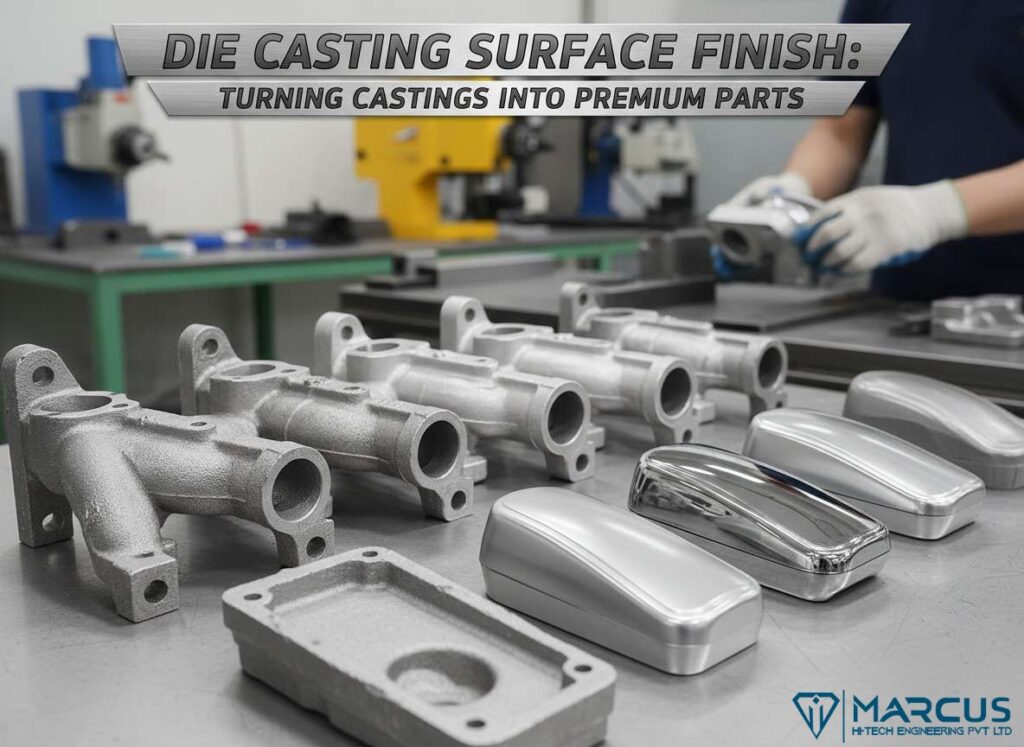
Die casting produces parts with excellent as-cast surface quality, but the journey doesn’t end when the part leaves the mold. Most applications require additional treatments for corrosion protection, enhanced aesthetics, or functional properties.
Understanding your die casting surface finish options ensures you specify the right treatment to balance performance and cost.
Why Surface Finishing Matters
Raw die-cast parts are functional, but finishing elevates them to “premium” status. Key reasons include:
- Corrosion Resistance: Protecting aluminum and zinc alloys from environmental degradation.
- Aesthetic Appeal: Creating specific colors, textures, and high-gloss visual effects.
- Wear Resistance: Hardening surfaces for demanding mechanical applications.
- Electrical Properties: Adding conductivity or providing critical insulation.
- Porosity Sealing: Creating leak-tight components for fluid-handling applications.
1. Sandblasting: The Ultimate Surface Prep
Sandblasting (or shot blasting) is often the first step in the finishing process. It uses compressed air to propel abrasive media—like glass beads, aluminum oxide, or steel shot—against the part.
- Applications: Removes the “casting skin,” eliminates surface contamination, and creates a uniform matte texture.
- The Advantage: It improves coating adhesion by 30–40%, making it the essential pre-treatment for painting or powder coating.
2. Powder Coating: Durable and Versatile
Powder coating involves applying electrostatically charged dry powder that is then heat-cured at 200°C. It is the gold standard for aluminum die-cast parts.
- Durability: Achieve 80–120μm thickness in one step—significantly harder and more durable than liquid paint.
- Appearance: Available in over 200 RAL colors with various textures (metallic, wrinkled, or high-gloss).
- Eco-Friendly: A VOC-free process that complies with EU RoHS standards.
- Best For: Outdoor furniture, automotive housings, and consumer appliances.
3. Anodizing: The Aluminum Standard
Anodizing is an electrochemical process that converts the aluminum surface into a durable, integrated aluminum oxide layer (Al₂O₃). Unlike paint, this finish bonds molecularly and cannot chip or peel.
Types of Anodizing
- Type II (Sulfuric Acid): The most common decorative finish. It offers moderate corrosion protection and comes in a vibrant spectrum of dyed colors.
- Type III (Hard Anodize): Focused on function. It creates a thicker, ultra-hard coating (>600HV) for superior wear resistance in aerospace or medical instruments.
Technical Note: High-silicon alloys (like A380) can result in irregular finish thickness. For premium anodizing results, the quality of the die casting—including grain size and phase distribution—is critical.
4. Plating: Metallic Protection
Plating deposits a thin layer of metal (nickel, chrome, or zinc) onto the part through electrochemical or chemical processes.
- Electroplating: Used for decorative chrome (mirror-like finish) or zinc (cost-effective protection).
- Electroless Nickel Plating (ENP): A chemical process that provides uniform coverage even on complex internal geometries. It offers excellent solderability for electronic applications.
- Key Consideration: Chrome is highly aesthetic but is often the most expensive finish due to the labor involved in the plating process.
5. Specialty Finishes
- Chromate Conversion Coating: A cost-effective primer for paint or a standalone conductive coating (e.g., Alodine).
- E-Coat (Electrophoretic Coating): Electrically applied paint that provides complete, uniform coverage on complex geometries.
- Impregnation: A critical process that uses vacuum and pressure to force sealant into microscopic voids, creating watertight, leak-free components.
- Teflon/PTFE: Provides a non-stick, low-friction surface ideal for food processing or high-temperature industrial equipment up to 260°C.
Selecting the Right Die Casting Surface Finish
When specifying a treatment, evaluate your operating environment and dimensional tolerances. Some finishes, like Type III hard anodizing, can add up to 0.001″ of thickness, which may affect tight-tolerance assemblies.
| Factor | Premium Choice | Budget Choice |
|---|---|---|
| Environment | Hard Anodizing / ENP | Chromate Conversion |
| Aesthetics | Chrome Plating | Powder Coating |
| Wear | Type III Hard Anodize | Sandblasting |
| Tolerance | Thin ENP | E-Coat |
The Bottom Line
The right die casting surface finish transforms a raw casting into a high-performance component. While it is tempting to choose the cheapest option, a premium finish that extends product life and reduces warranty claims often provides the best long-term value.