


- By Marcus
- 10 Feb 2026
- No Comments
One Pour. One Mold. One Perfect Part. How the Die Casting Process Works.
Die casting stands as one of manufacturing’s most precise and efficient methods for producing high-quality metal components. From automotive engine blocks to smartphone housings, this versatile process delivers the intricate parts that power our modern world. Whether you’re an engineer, manufacturer, or simply curious about how metal products come to life, understanding die casting provides valuable insight into a cornerstone of industrial production.
In this comprehensive guide, we’ll walk through each critical stage of the die casting process, revealing how molten metal transforms into precision-engineered components ready for real-world applications.
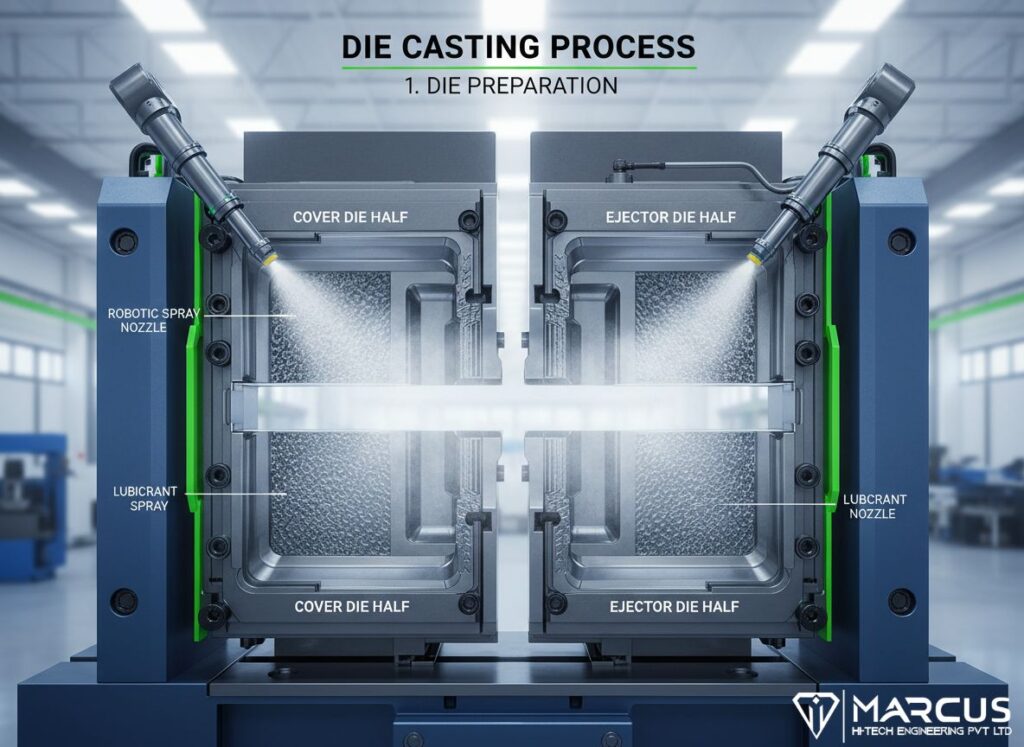
1. Preparation: Setting the Stage
The process begins with meticulous preparation of the mold (or “die”). This critical first step sets the foundation for a defect-free part.
- Lubrication: Technicians spray the interior surfaces of the die halves with a specialized lubricant. This regulates temperature and ensures the final part can be removed without sticking.
- Clamping: Once prepped, the die halves—the cover side and the ejector side—are clamped shut with massive hydraulic force (often hundreds of tons) to withstand the intense pressure of the coming injection.
2. Injection: The Heart of the Process
This is where the transformation happens. Molten metal—typically aluminum, zinc, or magnesium—is forced into the die cavity at high velocity.
- The Shot: Under pressures ranging from 10 to 175 MPa, the metal fills every corner of the mold.
- Hot vs. Cold Chamber: Zinc and magnesium often use Hot-Chamber injection (where the mechanism is submerged in metal), while aluminum requires Cold-Chamber injection (where metal is ladled in manually or robotically).
3. Cooling: Controlled Solidification
Once the cavity is full, the metal must transition from liquid to solid. This isn’t just a waiting period; it’s a controlled thermal event.
- Thermal Management: Water or oil cooling channels machined directly into the die whisk heat away.
- Precision: If the part cools too quickly, it can become brittle; too slowly, and it may warp. Proper cooling ensures the metal achieves the correct grain structure and strength.
4. Ejection: The Big Reveal
With the part solidified, the die halves separate. Because metal shrinks as it cools, it naturally “grips” the mold’s features.
- Ejector Pins: A series of strategically placed pins drive forward, pushing the casting out of the mold cavity.
- The Casting Assembly: At this stage, the part is still attached to the runners (the paths the metal took to get inside) and overflows (pockets that catch air and impurities).
5. Trimming: The Finishing Touch
The final step is to separate the “wheat from the chaff.” Trimming removes all the excess material necessary for the casting process but unwanted on the final component.
- Deflashing: Using a specialized trim die, the excess metal—known as flash and runners—is sheared away in a single stroke.
- The Green Loop: A major advantage of die casting is sustainability; the trimmed scrap is simply tossed back into the furnace to be melted down for the next batch, resulting in nearly zero material waste.
Why Die Casting Dominates
| Advantage | Benefit |
|---|---|
| Complexity | Produces thin-walled, intricate shapes machining cannot replicate. |
| Speed | Cycle times can be as fast as 20–30 seconds. |
| Durability | High-pressure injection creates a dense, high-strength molecular structure. |
Conclusion
From furnace to finishing line, die casting remains the gold standard for high-volume, high-precision metal manufacturing—powering everything from automobiles to electronics with remarkable efficiency and consistency.