Gravity Die Casting : Process, Advantages and Applications.
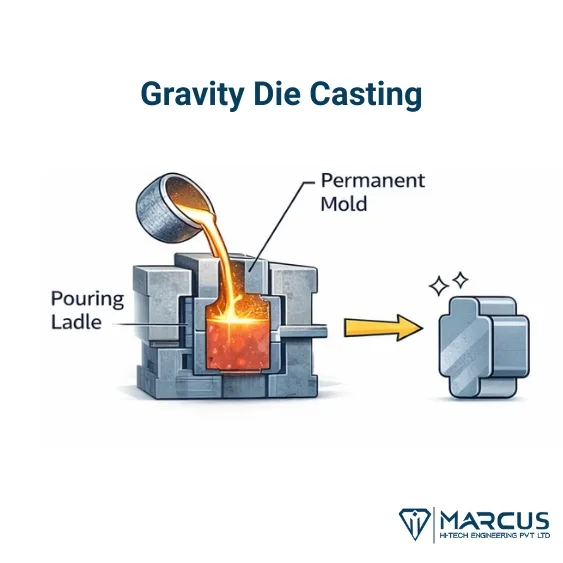
Master gravity die casting: Process, machines, and pros/cons. Learn why GDC is the top choice for high-strength metal parts in 2026.
Read article →
In die casting, choosing the right chamber type is one of the most critical decisions an engineer or buyer can make. It’s not just about the machine—it’s about alloy melting point, production speed, part quality, and equipment longevity.
Selecting the wrong process can lead to excessive porosity, premature tooling failure, or even damage to the casting machine. Below is a clear breakdown of the two industry-standard processes and when to use each.
Often referred to as gooseneck casting, hot chamber die casting is the gold standard for high-speed, high-volume production of alloys with low melting points.
How the Process Works
In a hot chamber machine, the injection system is submerged directly in the molten metal. A piston forces the metal through a “gooseneck” tube and into the die cavity.
Because the molten metal is already inside the machine:
Best Metals for Hot Chamber
This process is limited to alloys that will not erode or “attack” the submerged steel components.
When working with high-melting-point alloys like aluminum, the furnace must be separated from the casting machine to protect the injection system from extreme heat.
How the Process Works
In cold chamber die casting:
While the additional ladling step increases cycle time, it is mandatory for protecting the machine’s longevity.
Best Metals for Cold Chamber
Cold chamber is the only viable choice for alloys that melt at high temperatures.
| Feature | Hot Chamber | Cold Chamber |
|---|---|---|
| Furnace Location | Internal (Built-in) | External (Separate) |
| Production Speed | Very High (Fastest) | Moderate (Ladle step included) |
| Common Alloys | Zinc, Magnesium, Lead | Aluminum, Copper, Brass |
| Part Size | Small to Medium | Small to Giga-Castings |
| Tooling Life | Long (Lower heat stress) | Moderate (High thermal fatigue) |
The choice isn’t just about the metal; it’s about the business goals of your project:
Pro-Tip for 2026: If your design involves thin walls and intricate detail, Zinc in a Hot Chamber setup often allows for tighter tolerances (up to $\pm 0.05$mm) than Aluminum in a Cold Chamber.
More process, tooling, and sourcing notes from the Marcus engineering team.
Master gravity die casting: Process, machines, and pros/cons. Learn why GDC is the top choice for high-strength metal parts in 2026.
Read article →Learn what HVM means in manufacturing, what defines high-volume production, and how die casting enables fast, consistent, cost-efficient.
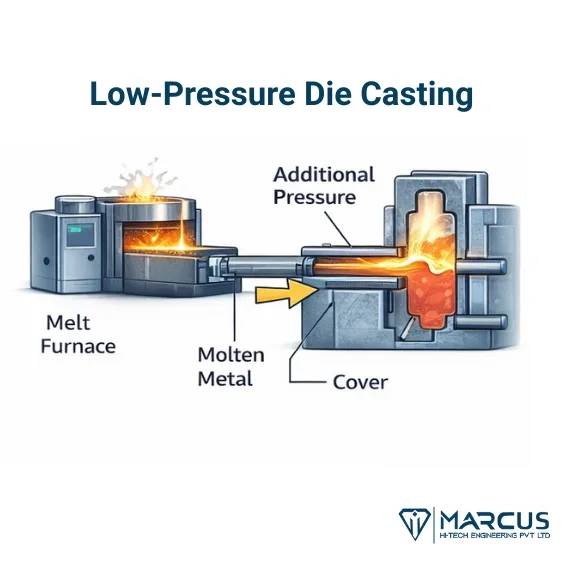
Read article →LPDC is a controlled process using low pressure to produce high-strength, low-porosity aluminum parts with superior quality and consistency
Read article →