


- By Marcus
- 03 Feb 2026
- No Comments
What Is Low Pressure Die Casting? Process, Pressure, and Strategic Advantages
While High Pressure Die Casting (HPDC) is built for extreme speed, Low Pressure Die Casting (LPDC) is engineered for structural integrity. If you are manufacturing safety-critical components—like automotive wheels or suspension parts—LPDC is often the mandatory choice.
This post breaks down why this “gentle” injection method produces the highest quality metal parts in the industry.
What Is Low Pressure Die Casting?
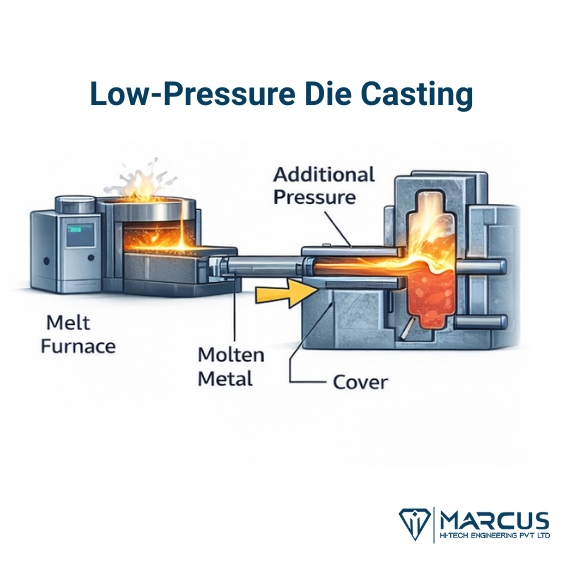
Low Pressure Die Casting is a process where molten metal is moved from a sealed furnace into a mold using controlled gas pressure rather than a high-speed hydraulic plunger.
The defining characteristic of LPDC is laminar flow. The metal enters the mold slowly and smoothly from the bottom up. This prevents the “splashing” or turbulence seen in high-pressure methods, which significantly reduces air entrapment and oxides.
The LPDC Process: Step-by-Step
- Setup: A sealed holding furnace containing molten metal is positioned directly beneath the mold.
- Pressurization: Low air pressure (0.2 to 1.5 bar) is applied to the furnace.
- Filling: The pressure forces the molten metal up through a refractory “riser tube” into the die cavity.
- Solidification: Pressure is maintained as the part cools. This “feeds” the mold, compensating for metal shrinkage and creating a dense, uniform structure.
- Release: Once solidified, the pressure is released, and any excess molten metal in the riser tube flows back into the furnace for the next cycle.
Technical Specs: The Pressure Range
Engineers often ask how “low” the pressure actually is.
- LPDC Pressure: Typically 3–22 psi (0.2–1.5 bar).
- HPDC Pressure (for comparison): Often exceeds 10,000–20,000 psi.
By maintaining this low, steady pressure, the machine creates a crystalline structure that is far superior to gravity casting, without the porosity risks of high-pressure injection.
Key Advantages for 2026 Manufacturing
- Virtually Zero Porosity: Ideal for pressure-tight parts like manifolds and fuel systems.
- Superior Mechanical Properties: LPDC parts have high tensile strength and are fully heat-treatable (T6)—something standard HPDC parts often cannot handle.
- High Material Yield: Because there are no heavy “runners” or “risers” to trim off, material utilization is often above 90%, significantly reducing scrap costs.
- High Purity: Since the metal is drawn from the middle of the furnace via the riser tube, surface dross and impurities never enter the mold.
LPDC vs. HPDC: At a Glance
| Feature | Low Pressure (LPDC) | High Pressure (HPDC) |
|---|---|---|
| Filling Speed | Slow & Controlled | Ultra-Fast & Turbulent |
| Part Density | Extremely High | Moderate (Risk of gas holes) |
| Heat Treatment | Yes (Fully Compatible) | Limited / Not Recommended |
| Best For | Structural / Critical Parts | Thin-Walled / High Volume |
| Cycle Time | 1–3 Minutes | 15–60 Seconds |
Summary: Is LPDC Right for You?
Choose Low Pressure Die Casting if your priority is strength and reliability over raw production speed. It is the gold standard for alloy wheels, engine heads, and structural EV components that must withstand high stress without failure.
Need high-strength aluminum parts? The Marcus Manufacturing team specializes in LPDC for safety-critical industries. Contact us for a technical consultation.