Types of Die Casting Processes Offered I Die Casting Suppliers
Discover a range of die casting process in India, including pressure, vacuum, and gravity methods.
Read article →
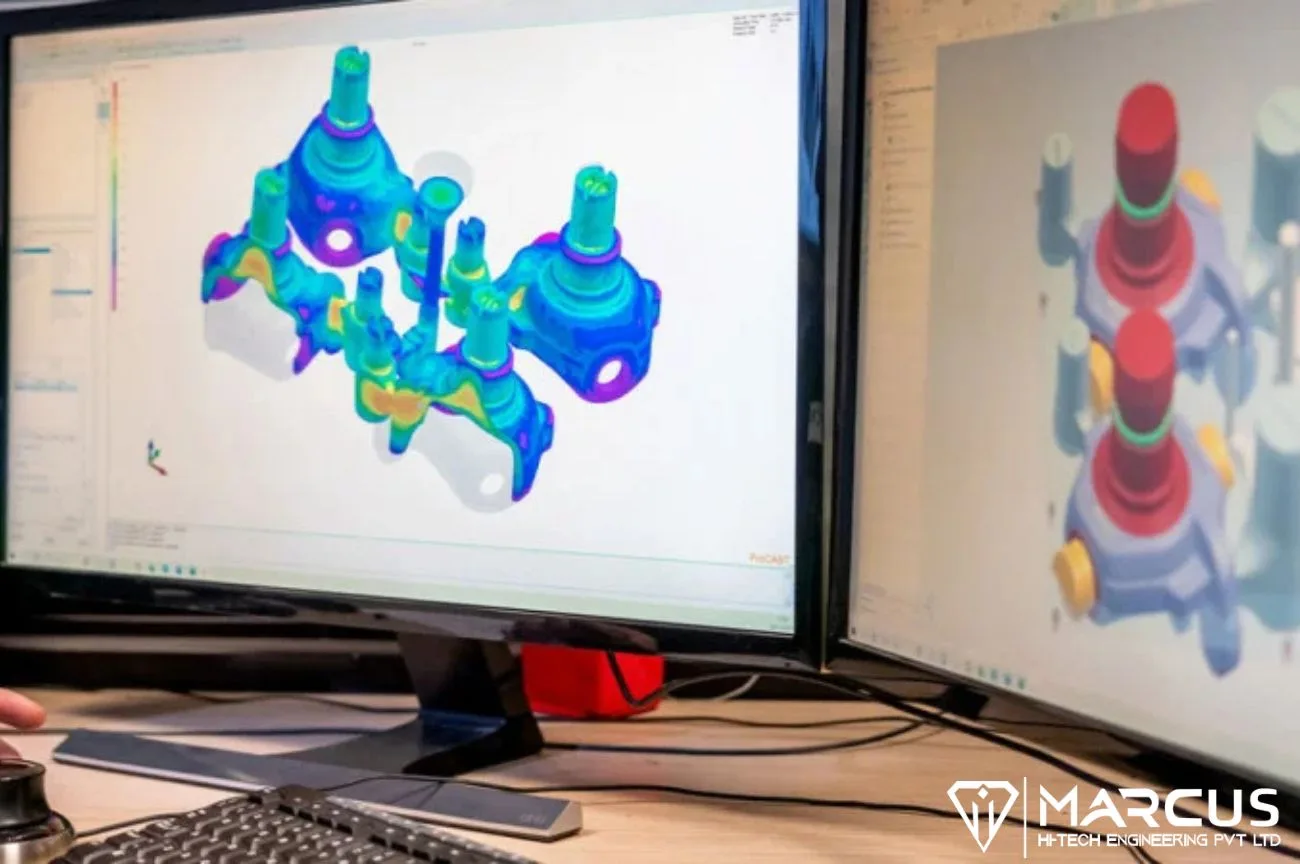
High-pressure die casting (HPDC) is a widely adopted manufacturing technique for producing intricate and lightweight components with exceptional mechanical properties. In fact, high-pressure die casting is responsible for manufacturing approximately 70% of all aluminum parts in the automotive industry alone. This highlights the significance of this process in modern manufacturing.
However, achieving the desired quality and efficiency in high-pressure die casting can be a complex task. Factors such as porosity, shrinkage defects, and dimensional inaccuracies can significantly impact the final product’s integrity. This is where simulation software comes into play, offering valuable insights and predictive capabilities that help optimize the process.
Simulation software has become an indispensable tool for engineers and manufacturers involved in high-pressure die casting. It enables them to simulate and analyze the intricate dynamics of the process, allowing for fine-tuning and optimization of various parameters. By virtually exploring different scenarios, engineers can reduce the number of costly trial-and-error iterations, saving time and resources.
Let us understand the role of simulation software in high pressure die casting, the underlying principles it employs, and its applications in different industries.
High-pressure die casting is a highly efficient and versatile manufacturing process to produce complex and precision-engineered parts. It is widely employed in automotive, aerospace, electronics, and other industries, where lightweight and durable components are in demand.
Let’s take a closer look at the process steps and the significance of high-pressure die casting in modern manufacturing.
Understanding the high-pressure die casting process and its significance lays the foundation for recognizing the importance of simulation software in optimizing this manufacturing technique.
Simulation software is essential for high-pressure die casting (HPDC) to improve product quality, efficiency, and cost-effectiveness.
Flaws in HPDC, like porosity and air entrapment, can harm the final product’s performance. Engineers use simulation software to detect potential defect areas before casting begins. The software recommends die design improvements by analyzing molten metal flow, solidification patterns, and thermal behavior. This proactive method optimizes casting, reduces defects, and ensures higher-quality parts.
Simulation software can help optimize the HPDC process by testing different scenarios virtually. Engineers can see how parameter variations affect the process and identify the most efficient and effective process parameters to improve part quality, reduce scrap rates, and increase productivity.
Using high-pressure die casting Simulation software allows engineers to analyze die designs before manufacturing, optimizing factors like fill time, flow velocity, and pressure distribution. This helps reduce errors, minimize defects, and improve part quality while reducing production costs.
By utilizing simulation software in HPDC, the need for physical prototypes and trial-and-error iterations is significantly reduced. This allows engineers to test and optimize process parameters, die designs virtually, and part geometries to identify potential issues early on. As a result, costly rework and tooling modifications can be minimized, resulting in significant cost savings and shortened development cycles. Additionally, simulation software enables faster decision-making and rapid design iterations, ultimately accelerating the production timeline.
Solidification and cooling directly affect die-cast parts’ mechanical properties and dimensional stability. With the help of simulation software, engineers can gain detailed insights into the solidification behavior, temperature gradients, and cooling rates during the casting process. They can optimize the cooling system, select appropriate cooling channels, and determine the ideal quenching methods by analyzing these aspects. This results in consistent and controlled solidification, minimizing defects and achieving the desired material properties.
Simulation software used in high-pressure die casting (HPDC) relies on advanced computational techniques to accurately model and predict the behavior of molten metal during the casting process.
Two primary methods employed in simulation software for HPDC are computational fluid dynamics (CFD) and finite element analysis (FEA). Let’s explore the working principles of these techniques.
CFD simulates fluid movement, heat transfer, and more. In HPDC, it models the flow of molten metal in the die cavity.-
1.Geometry Representation: The die cavity and associated components, such as gates, runners, and cooling channels, are digitally represented within the simulation software.
2.Mathematical Equations: The Navier-Stokes equations, which describe the conservation of mass, momentum, and energy, are solved numerically to simulate the flow of molten metal. Additional equations account for factors like heat transfer and phase change.
3.Mesh Generation: The die cavity and associated components are divided into a finite number of small elements or cells to create a mesh. The mesh serves as the computational domain for solving the governing equations.
4.Boundary Conditions: Boundary conditions, such as injection pressure, temperature, and material properties, are specified to replicate real-world conditions accurately.
5.Solution Iteration: The numerical equations are solved iteratively, considering factors like fluid viscosity, velocity, pressure, and temperature distribution. This process simulates the flow behavior of molten metal, including filling, solidification, and cooling.
6.Visualization and Analysis: The simulation software generates visual representations, such as flow patterns, temperature distributions, and solidification fronts, to help engineers analyze and optimize the casting process.
FEA is a computational method used to analyze the behavior of solid structures subjected to various loads and boundary conditions. In the context of HPDC, FEA is used to simulate the solidification and cooling of molten metal within the die. The working principles of FEA in HPDC simulation are as follows:
1.Geometry Representation: The die, including the die cavity, cores, and cooling channels, is digitally represented within the simulation software.
2.Material Properties: Material properties, such as thermal conductivity, specific heat capacity, and solidification characteristics, are assigned to the die material and the molten metal.
3.Mathematical Equations: The heat transfer equations, including conduction, convection, and radiation, are solved numerically to simulate the solidification and cooling process. The equations consider factors like temperature gradients, phase change, and latent heat.
4.Mesh Generation: The die and associated components are discretized into a mesh of small elements or nodes. The mesh provides the computational domain for solving heat transfer equations.
5.Boundary Conditions: Boundary conditions, such as die temperature, cooling channel flow rates, and contact conditions, are defined to mimic the actual operating conditions.
6.Solution Iteration: The numerical equations are solved iteratively to determine the die’s temperature distribution and solidification patterns. The process considers factors like heat transfer rates, cooling efficiency, and the influence of the surrounding environment.
7.Visualization and Analysis: The simulation software generates visual representations, such as temperature contours and solidification profiles, enabling engineers to analyze and optimize the solidification and cooling processes.
Engineers can use simulation software to detect defects in the casting process before production starts. By simulating the flow of molten metal, solidification patterns, and thermal behavior, the software can predict areas where defects like porosity, shrinkage, and air entrapment are likely to occur.
Early identification of these defects enables engineers to adjust the die design, process parameters, or cooling systems to prevent or reduce their occurrence. This ultimately leads to better part quality by lowering scrap rates and improving the structural integrity of die-cast components.
HPDC involves many process parameters, including injection pressure, filling time, die temperature, and gating system design. Determining the optimal values for these parameters traditionally required costly and time-consuming trial-and-error methods. Simulation software provides a virtual platform for engineers to test and optimize process parameters, reducing the need for physical prototypes.
Engineers can identify the most efficient and effective settings by simulating different scenarios and analyzing the effects of parameter variations. This optimization process leads to improved part quality, reduced production costs, and enhanced productivity in HPDC.
The design of the die is critical in ensuring successful and efficient HPDC. Simulation software allows engineers to analyze and optimize die designs before manufacturing. By simulating the flow of molten metal through the die cavity, software tools can evaluate factors such as fill time, flow velocity, and pressure distribution. This information helps optimize the die design, ensuring uniform filling, reducing turbulence, and minimizing the potential for defects.
The ability to visualize and analyze the die design virtually saves time and resources by reducing the need for physical modifications and costly rework.
Implementing simulation software in HPDC significantly reduces the reliance on physical prototypes and costly trial-and-error iterations. By virtually testing and optimizing the process parameters, die designs, and part geometries, engineers can identify potential issues early on, minimizing rework and tooling modifications. This results in substantial cost savings and shortened development cycles.
Simulation software provides engineers with a powerful tool to explore innovative design concepts and push the boundaries of part geometries. By simulating the casting process and its effects on different design variations, engineers can assess the feasibility and performance of complex geometries, lightweight structures, and intricate details. This ability to experiment and iterate virtually promotes design freedom and encourages innovation in HPDC.
Simulation software facilitates effective collaboration and communication among team members involved in the HPDC process. The software produces easy-to-understand visual representations that can be easily shared. This fosters effective communication between design engineers, process engineers, and stakeholders, promoting collaboration and alignment throughout the production cycle.
High-pressure die casting (HPDC) simulation software has various applications that help engineers improve the process and enhance the quality of parts. It allows for filling analysis, optimizing gating and runner designs, solidification and cooling analysis to enhance mechanical properties and dimensional stability, and predicting and preventing defects.
Additionally, simulation software enables the optimization of process parameters, die design, and material selection and evaluation. This software allows manufacturers to achieve efficient and high-quality HPDC, reduce defects, and enhance productivity.
Also Check: The Importance of Tooling and Mold Design in Pressure Die Casting
Simulation software has revolutionized the high-pressure die casting industry, enabling manufacturers to achieve higher-quality products while reducing costs and production time. By accurately predicting process variables and identifying potential defects, these tools empower engineers to optimize part design, improve tooling, and enhance overall manufacturing efficiency. As technology advances, simulation software will undoubtedly play an increasingly critical role in the future of high-pressure die casting.
1. What is the use of simulation software for casting?
Simulation software for casting is used to model and analyze the casting process virtually. It helps in predicting and optimizing outcomes, such as the final product’s quality, defects, and material distribution. By simulating different parameters like temperature, mold design, and material properties, it aids in reducing production costs and time by identifying potential issues before actual casting. This software is crucial for ensuring efficiency, minimizing defects, and achieving better overall casting results.
2. What tools are used in die casting?
Die casting typically employs a set of essential tools and equipment:
Die Casting Machine: This machine is at the core of the process, injecting molten metal into molds.
Dies or Molds: These are the custom-made tools used to shape and form the final product.
Ladles and Furnaces: Ladles transport and pour molten metal, while furnaces melt and maintain metal in a liquid state.
Trim Dies: These are used to remove excess material from the final casting.
Spraying and Cooling Systems: Tools for applying release agents and cooling the casting quickly for easier removal.
3. Why do we need simulation software?
Simulation software is essential for modeling real-world scenarios in a virtual environment, allowing us to predict outcomes and test hypotheses without real-world risks.
It helps in understanding complex systems, optimizing processes, and making informed decisions by providing a safe and cost-effective testing platform.
Simulation software is vital in various industries, from manufacturing and healthcare to aerospace and finance, to improve efficiency and reduce errors.
It aids in training and skill development, enabling individuals to practice and gain experience in controlled simulations before facing real-life situations.
Ultimately, simulation software enhances innovation, problem-solving, and decision-making by providing a powerful tool for analysis and experimentation.
4. What is simulation software in manufacturing?
Simulation software in manufacturing is a digital tool used to replicate real-world manufacturing processes. It creates a virtual environment where different aspects of production, like assembly lines or logistics, can be tested and optimized. This software helps manufacturers analyze scenarios, improve efficiency, reduce costs, and enhance product quality. It’s a valuable tool for planning and decision-making, enabling businesses to make informed choices before implementing changes in their production processes. Overall, simulation software plays a crucial role in improving manufacturing operations.
More process, tooling, and sourcing notes from the Marcus engineering team.
Discover a range of die casting process in India, including pressure, vacuum, and gravity methods.
Read article →Top IATF certified aluminium die casting for Chennai’s EV & Auto hubs. In-house tooling & CNC machining. Get a quote today!
Read article →Compare aluminum vs steel cost. Learn how weight reduction and lower maintenance deliver higher ROI for automotive and OEMs.
Read article →