Introduction
US electric vehicle sales hit 1.6 million units in 2024, crossing 10% market share for the first time — and Q1 2025 added another 360,000 units, up 10% year-over-year. That growth is putting real sourcing pressure on OEMs and startups alike: finding manufacturers capable of producing the structural, electronic, and electromechanical components that make EVs work, without building every capability in-house.
Battery enclosures, motor housings, inverter electronics, wire harnesses, thermal management parts — these components are capital-intensive to produce and demand highly specialized processes. Contract manufacturers exist to close that gap, giving EV companies access to certified production capacity without the cost or timeline of a greenfield investment.
This article covers the top 10 contract manufacturers for EV components in the USA, what each one specializes in, and the criteria used to evaluate them — giving you a clear starting point for shortlisting the right partner for your specific component need.
TL;DR
- EV component categories span electronics (BMS, inverters, onboard chargers), structural metal (die-cast housings, battery trays), powertrain assemblies, and high-voltage wire harnesses — identify your category before shortlisting suppliers
- IATF 16949:2016 is the baseline quality certification; also look for ISO 26262 functional safety coverage on electronic control components
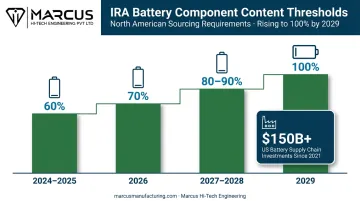
- The IRA's North American battery component content requirement rises from 60% in 2024–2025 to 100% by 2029 — domestic or nearshore sourcing is no longer optional for tax credit compliance
- The 10 manufacturers below were evaluated on EV-specific technical capability, US production presence, automotive-grade certifications, and industry reputation — not company size alone
- For non-IRA-restricted components, IATF 16949-certified global manufacturers can complement US supply chains and offset cost pressure without affecting tax credit eligibility
Overview of Contract Manufacturing for EV Components in the USA
In practical terms, the OEM or startup owns the design and IP; the contract manufacturer handles tooling, production, quality inspection, and often sub-assembly. Component categories most commonly outsourced include:
- Die-cast aluminum battery enclosures and motor housings
- Stamped metal battery trays
- Machined powertrain parts
- PCB assemblies for BMS and onboard chargers
- Wire harnesses
- Thermal management modules
The policy backdrop matters here. The Inflation Reduction Act created a direct financial incentive for North American component sourcing — battery component content requirements escalate from 60% today to 100% by 2029. This has accelerated OEM qualification of domestic and nearshore suppliers across every component category. The DOE has tracked more than $150 billion in announced US battery supply chain investments since 2021, with the potential to create more than 100,000 jobs.
Those investment flows have expanded which supplier types qualify. The manufacturers below represent a considered mix shaped by that landscape: pure electronics contract manufacturers, Tier-1 suppliers that produce to customer design, structural metal specialists, and electrical architecture providers. Not all are interchangeable "contract manufacturers" in the traditional sense — that distinction is covered for each entry.
Top 10 Contract Manufacturers for EV Components in the USA
The companies below were selected based on verified EV component manufacturing capability, relevant certifications, US production presence, and industry reputation — not purely on revenue or brand scale.
1. Jabil Inc.
Founded in 1966 and headquartered in St. Petersburg, Florida, Jabil operates one of the most comprehensive design-to-manufacturing platforms in the electronics contract manufacturing space. For EV applications, its automotive division specifically covers battery management system (BMS) electronics, power electronics, onboard chargers, and EV charging hardware.
What sets Jabil apart is its design-for-manufacturing capability alongside volume production — meaning EV OEMs can engage Jabil from early engineering stages rather than only at production handoff. In 2025, Jabil signed an MOU with AVL covering design and manufacturing for next-generation vehicle technologies, though no specific named OEM production award has been publicly disclosed. Jabil's automotive production facilities operate under IATF 16949 certification, and its design processes are ASIL-certified for functional safety.
| Category | Detail |
|---|---|
| Key EV Components | BMS PCBAs, power electronics assemblies, inverter electronics, EV charger modules, onboard chargers |
| Certifications | IATF 16949 (automotive facilities), ISO 9001, ASIL-certified design processes; site-specific UL scope not publicly verified |
| US Manufacturing | St. Petersburg, FL (headquarters/production); additional US facilities support automotive programs — specific EV-dedicated sites not publicly detailed |
2. Flex Ltd.
Originally Flextronics, Flex is now headquartered in Austin, Texas, and operates one of the largest automotive and e-mobility contract manufacturing networks globally. Its automotive portfolio includes BMS, power inverter sub-assemblies, high-voltage DC-DC converters, onboard chargers, and electromechanical modules for EV platforms.
Flex's "Sketch-to-Scale" engineering model — covering concept through volume production — and its Flex Pulse supply chain visibility platform give EV programs real-time supply chain transparency from prototype through production. Flex recently announced US manufacturing expansion to support AI-driven power demand, with a new Dallas facility; its automotive segment has documented EV-relevant capabilities across North American locations, though specific site-level IATF 16949 certificates for EV programs are not publicly verified.
| Category | Detail |
|---|---|
| Key EV Components | Power converters, inverter sub-assemblies, BMS electronics, onboard chargers, electromechanical EV modules |
| Certifications | IATF 16949, ISO 9001 (automotive supplier requirements documented); site-level EV program certificates not publicly verified |
| US Manufacturing | Austin, TX (headquarters); Dallas, TX (new facility); North American automotive production footprint — specific EV plant locations not publicly confirmed |
3. Sanmina Corporation
San Jose, California-based Sanmina is one of the few contract electronics manufacturers with fully integrated PCB fabrication and assembly under a single roof — a meaningful supply chain control advantage for automotive-grade electronics. Its automotive manufacturing scope covers engine and body control units, BMS power converters, and PCB assembly/SMT for automotive applications.
For EV programs, Sanmina's vertically integrated model means fewer handoffs between PCB fab and assembly, which reduces lead time and defect risk on high-reliability electronics. Quality certifications include ISO 9001, IATF 16949, and AS9100D across its facility network. A current US-site-specific IATF certificate scoped to EV production has not been publicly verified.
| Category | Detail |
|---|---|
| Key EV Components | BMS power converter assemblies, automotive control units, gateway electronics, PCB/SMT assembly for EV applications |
| Certifications | IATF 16949, ISO 9001, AS9100D; US EV-specific site certificate not publicly verified |
| Core Differentiator | In-house PCB fabrication + assembly — eliminates third-party fab dependency for automotive-grade EV electronics |
4. BorgWarner Inc.
Headquartered in Auburn Hills, Michigan, BorgWarner has spent the past decade transitioning from ICE driveline components to a focused EV powertrain technology portfolio. Its EV product range covers inverters, eMotors, DC-DC converters, onboard chargers, and high-voltage thermal management systems.
Important distinction: BorgWarner is primarily a proprietary Tier-1 technology supplier — it develops and owns the IP on its powertrain products — rather than a neutral build-to-print contract manufacturer. Some OEM engagements may involve customer-specific programs, but buyers should verify the specific commercial model before treating BorgWarner as a general-purpose CM. BorgWarner has announced North American inverter program awards with major OEMs.
| Category | Detail |
|---|---|
| Key EV Components | Inverters, eMotors, DC-DC converters, onboard chargers, high-voltage thermal management modules |
| Certifications | IATF 16949 (Krakow site verified); ISO 26262 functional safety compliance — current US EV-site certificate not publicly verified |
| EV Focus | Powertrain electrification; differentiated from EMS providers by deep system-level EV engineering |
5. Dana Incorporated
Maumee, Ohio-based Dana serves EV OEMs across thermal management, sealing, and electrification — three domains that are increasingly purchased as an integrated solution rather than separate supply relationships. Its verified scope includes e-drive systems, motors, inverters, battery cooling systems, and sealing solutions for EV platforms. Dana's eSP502 won a 2024 industry Powertrain Product of the Year award.
Like BorgWarner, Dana operates primarily as a proprietary Tier-1 supplier. Its US locations include the Maumee Sustainable Mobility Center and Toledo driveline operations, though specific US plant certifications scoped to EV passenger vehicle programs have not been publicly verified.
| Category | Detail |
|---|---|
| Key EV Components | E-drive assemblies, battery/electronics cooling, sealing systems, thermal management modules |
| Certifications | IATF 16949, ISO 9001, ISO 14001 required of suppliers; current US EV-site certification scope not publicly verified |
| Unique Capability | Thermal + sealing + electrification under one supplier relationship — reduces Tier-1 complexity for EV programs |
6. American Axle & Manufacturing (AAM)
Detroit-based AAM (now presented under Dauch Corporation) has pivoted its core driveline engineering heritage toward EV-specific products. Its 3-in-1 e-Beam electric drive technology was actively showcased at CES 2025 and has secured a business award for next-generation deployment.
AAM self-identifies as a global Tier-1 supplier of proprietary e-drive technology. Its deep US manufacturing base in Michigan and long-standing OEM relationships with major North American automakers transitioning to EVs make it a natural partner for integrated driveline electrification — but buyers should verify whether the specific engagement model matches a build-to-print CM need or a proprietary system purchase.
| Category | Detail |
|---|---|
| Key EV Components | Electric drive units, e-axles, 3-in-1 e-Beam systems, electric motors, driveline electrification assemblies |
| Certifications | IATF 16949, ISO 9001; US EV-specific site certificates not publicly verified |
| Primary Market | North American EV OEMs and automotive Tier-1 integration programs |
7. Arconic Corporation
Pittsburgh, Pennsylvania-based Arconic is a material and product supplier specialising in aluminum sheet, extrusions, and structural components for automotive applications — including closures, body structures, and heat exchanger materials. Its verified automotive output covers aluminum flat-rolled products and extrusions.
Scope note: Claims of Arconic performing die-cast or forged battery enclosure contract manufacturing were not verified in publicly available sources. Arconic is best characterised as an aluminum materials and formed-product supplier rather than a general EV component CM. Buyers seeking die-cast battery enclosures should verify specific process capability directly.
| Category | Detail |
|---|---|
| Key EV Components | Aluminum sheet and extrusions for body structures, closures, heat exchangers; specific EV battery enclosure contract manufacturing not publicly verified |
| Certifications | IATF 16949 (Hungary flat-rolled site verified); US EV-specific automotive plant certification not verified |
| Core Material Expertise | High-strength aluminum alloys for lightweighting — relevant to EV structural and thermal applications |
8. Autokiniton (formerly Tower International)
Tower International was acquired by Autokiniton in September 2019 and no longer operates as a standalone entity. Autokiniton, headquartered in New Boston, Michigan, continues the structural metal manufacturing business with capabilities in high-strength stampings and precision structural assemblies.
Autokiniton's core process strengths — high-volume metal stamping, resistance welding, and laser welding — are directly applicable to EV battery trays, underbody structures, and body-in-white components. Autokiniton has not publicly confirmed specific EV battery tray programs or current site-level IATF certifications, so direct capability verification is recommended.
| Category | Detail |
|---|---|
| Key EV Components | Stamped structural components, potential battery tray and underbody assembly capability — specific EV programs not publicly verified |
| Certifications | IATF 16949, ISO 9001 expected; site-level EV scope not publicly verified |
| Process Focus | High-volume metal stamping, resistance welding, laser welding for structural assemblies |
9. Martinrea International
Headquartered in Vaughan, Ontario, Martinrea has significant US operations in Michigan and Ohio. Its 2025 annual report documents HPDC structural parts, hydroforming, battery enclosures, thermal management, and fluid systems — with Lucid named among customers. That's one of the more specific EV program references on this list.
Martinrea's combination of aluminum-intensive structures, hydroforming, and fluid-carrying systems is particularly well-suited to EV battery cooling circuits, where thermal management passages and structural enclosure requirements must be satisfied simultaneously. Its US engineering and lightweighting R&D hub is in Auburn Hills, Michigan, though precise Ohio EV-site production roles were not verified.
| Category | Detail |
|---|---|
| Key EV Components | Aluminum structures, HPDC structural parts, battery enclosures, fluid management modules, hydroformed components |
| Certifications | ISO 9001-accredited testing, ISO 14001 requirements documented; North American site-level IATF 16949 not publicly verified |
| EV Capability | Hydroforming + aluminum-intensive manufacturing aligned to EV lightweighting and thermal system requirements |
10. Aptiv PLC
Registered in Dublin with major US operations in Troy, Michigan, Aptiv is the specialist on this list for electrical architecture. Its product range covers high-voltage connectors rated 400–1,000V at up to 250A, high-voltage distribution systems, vehicle compute modules, and ADAS electronics assemblies.
Aptiv operates as a proprietary Tier-1 technology supplier in the electrical architecture space. For EV programs, its software-defined vehicle platforms and high-voltage wiring expertise address areas increasingly central to EV OEM product strategy. ASPICE is a software process assessment framework, not a product certification; site-level IATF 16949 and ISO 26262 certificates for US EV programs were not publicly verified.
| Category | Detail |
|---|---|
| Key EV Components | High-voltage wire harnesses, EV connectors (400–1,000V), vehicle compute modules, ADAS electronics assemblies |
| Certifications | IATF 16949, ISO 9001, ASPICE process framework, ISO 26262 — current US site-specific certificates not publicly verified |
| Core Differentiator | Electrical architecture and software-defined vehicle expertise beyond standard electronic or mechanical manufacturing |
How We Chose These EV Component Contract Manufacturers
Every manufacturer on this list was assessed against four primary dimensions: EV-specific technical capability (not just general automotive history), US production presence or a strong North American supply chain, automotive-grade quality certifications, and demonstrated experience with EV OEM programs.
A common buyer mistake is selecting a manufacturer based on brand recognition or overall revenue without verifying whether that manufacturer's certified processes, EV-specific tooling, and production capacity actually align with the component being sourced.
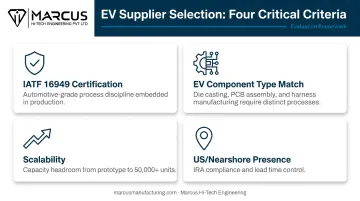
Key selection criteria and why they matter:
- IATF 16949:2016 certification: ensures automotive-grade process discipline — control plans, MSA, SPC — is embedded in production, not bolted on at inspection
- EV component type match: die casting, metal stamping, PCB assembly, and wire harness manufacturing require fundamentally different processes; a stamping specialist cannot substitute for an electronics CM
- Scalability from prototype to volume: programs that start at 1,000 units and ramp to 50,000 need a partner with headroom — verify machine capacity, tooling flexibility, and APQP depth
- US-based or nearshore presence: directly affects IRA compliance, delivery lead times, and logistics cost; increasingly non-negotiable for tax credit eligibility
Shortlist by component type first, then evaluate certification and capacity depth. Pairing a BMS electronics CM like Jabil or Sanmina with a structural metal specialist like Autokiniton or Martinrea is a smarter approach than expecting any single supplier to cover both.
Conclusion
The EV component contract manufacturing landscape in the USA spans four distinct specializations: electronics and control systems, structural metal fabrication, powertrain systems, and electrical architecture. The right partner is the one whose core process, quality certification, and EV program experience align directly with the component you need manufactured — not necessarily the one with the largest revenue.
When evaluating candidates, prioritize operational fit: can they support DFM and APQP early in the program? Do they have IATF 16949:2016 coverage at the specific site producing your parts? Can their capacity scale as your volumes ramp? Is their cost structure transparent enough for OEM procurement review?
For EV OEMs and Tier-1 suppliers sourcing die-cast aluminum battery enclosures, motor housings, and electromechanical assemblies, Marcus Hi-Tech Engineering offers:
- 45+ years of precision manufacturing experience across automotive and EV programs
- IATF 16949:2016 and ISO 9001 certification with in-house DFM and tooling simulation
- Die casting capability from 40T to 2,500T, covering a wide range of EV structural components
- Multi-country supply chain across India, Vietnam, and China for scalable, cost-efficient production
Reach out to Marcus to explore how its capabilities can support your EV component sourcing program.
Frequently Asked Questions
Who is the world's largest contract electronics manufacturer?
By revenue, Foxconn (Hon Hai Precision Industry) is the world's largest contract electronics manufacturer, reporting NT$8.1 trillion in FY2025 revenue (per Reuters). For EV-specific components, Jabil and Flex operate at the largest dedicated scale with established automotive and e-mobility programs.
What types of EV components are typically outsourced to contract manufacturers?
The main categories include BMS electronics and power converter PCBAs, die-cast aluminum battery enclosures and motor housings, stamped metal battery trays and structural assemblies, high-voltage wire harnesses, and thermal management components. The right contract manufacturer depends almost entirely on which of these categories you're sourcing.
What certifications should a contract manufacturer have to produce EV components?
IATF 16949:2016 is the baseline automotive quality management standard for most EV component production. ISO 9001 is the minimum for general manufacturing. ISO 26262 functional safety compliance is required for electronic control components, and RoHS/REACH compliance is expected for any electronics assembly.
What is the difference between a Tier-1 supplier and a contract manufacturer for EV components?
Tier-1 suppliers develop and own their component IP (proprietary inverters, e-drive systems, connectors) and sell finished products to OEMs. Contract manufacturers produce to the OEM's design without owning the product IP. Many Tier-1 suppliers also offer contract manufacturing services, which is why several entries on this list occupy both roles.
How does the Inflation Reduction Act affect EV component contract manufacturing in the USA?
The IRA requires battery components to be made or assembled in North America to qualify for the $7,500 EV tax credit, with content thresholds rising from 60% (2024–2025) to 100% by 2029. Suppliers outside North America without US or FTA-country partnerships may not satisfy these thresholds, directly affecting which contract manufacturers OEMs can qualify.
How do I evaluate a contract manufacturer for die-cast battery enclosures or motor housings?
Key evaluation criteria include:
- Die casting tonnage range and aluminum alloy capability
- IATF 16949 certification at the specific production site
- Tooling design and DFM simulation capability
- Inline inspection and CMM metrology systems
- Scalability across prototype, low-volume, and series production