What aluminum forging parts are used in electric vehicles?
Aluminum forging parts in electric vehicles are commonly used where high strength, low weight, and durability matter most. Typical applications include suspension components, brackets, housings, structural connectors, mounting parts, and other safety- or load-bearing components. Forging improves grain flow and mechanical performance, making it well suited for EV platforms that need lightweight parts without sacrificing structural integrity.
Why choose aluminum forgings for EV components instead of cast parts?
Aluminum forgings are often selected when a component needs higher mechanical strength, better fatigue resistance, and improved impact performance than many cast alternatives. For EV applications, that can be important in structural and dynamic-load parts. Castings may still suit complex geometries, but forgings are preferred when performance, grain structure, and durability are the primary design priorities.
Can Marcus machine forged aluminum EV parts to tight tolerances?
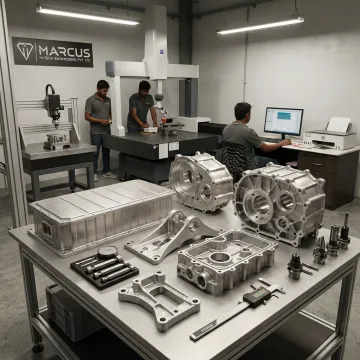
Yes. Marcus supports forged aluminum components with in-house CNC machining across 3-, 4-, and 5-axis platforms, including turn-mill capability. Critical features such as bearing bores, threaded interfaces, sealing surfaces, and mating faces can be machined to tight tolerances, with stated capability down to ±0.005 mm on key features where required by the application.
What quality standards does Marcus follow for EV aluminum forging programs?
Marcus operates under IATF 16949:2016 and ISO 9001 certified quality systems, which are especially relevant for automotive and EV supply chains. Programs are supported with structured controls such as supplier audits, APQP, PPAP, and FAIR inspection. Inline inspection, advanced metrology, and documented QA processes help maintain consistency from development through serial production.
Does Marcus offer tooling and development support for new EV parts?
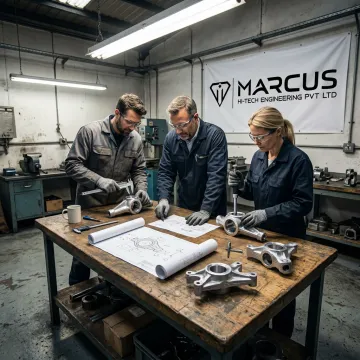
Yes. Marcus provides tool room and new product development support to help customers move from concept to production. Services include DFM review, CAD/CAM-based tooling support, simulation, rapid prototyping, T0 and T1 trials, engineering changes, and validation planning. This helps reduce development risk and improves manufacturability before full production begins.
Can forged EV parts also receive finishing or coating from Marcus?
Yes. Marcus offers in-house surface finishing and treatment options that can be applied alongside machining and production supply. Available processes include anodising, powder coating, blasting, plating, chromation, and heat treatment. Keeping finishing within the same managed supply chain can improve turnaround, simplify coordination, and support consistent batch-level documentation.
What production volumes can Marcus support for aluminum forging parts?
Marcus supports both development-stage and production-scale requirements through its certified partner network and integrated manufacturing capabilities. Forging press capacities range from 80T to 4000T, allowing support for a broad mix of part sizes and programme volumes. This flexibility helps customers source prototype quantities, pilot runs, and ongoing OEM or Tier production through one partner.
Which markets does Marcus serve for EV component manufacturing?
Marcus serves global customers across India, North America, the United Kingdom, Australia, Vietnam, Italy, Mexico, and the Middle East Asia region. Its manufacturing base in Coimbatore, India, combined with supply chain partners across India, Vietnam, and China, supports international sourcing strategies for OEMs and Tier suppliers seeking dependable aluminum component manufacturing.