Introduction
Aluminum forgings sit at the structural core of modern aerospace, automotive, and defense manufacturing. Unlike cast or machined alternatives, forged aluminum delivers aligned grain structure, superior fatigue resistance, and tighter tolerances — qualities that matter when a component is holding a wing spar together at altitude or carrying suspension loads at speed.
Choosing the right US-based aluminum forging supplier goes beyond press capacity. Quality consistency, certification compliance (AS9100, IATF 16949, Nadcap), and supply chain reliability are what separate a capable vendor from a true manufacturing partner.
That vetting process is getting more complex: the US aluminum forging market was valued at $1.38 billion in 2024 and is projected to reach $1.72 billion by 2032, growing at a 2.8% CAGR — driven by lightweighting mandates in automotive and sustained demand from aerospace and defense. More market activity means more supplier options, but not all of them are equal. Each company below was evaluated on press capacity, certification depth, sector specialization, and track record in high-stakes applications.
Key Takeaways
- Forged aluminum outperforms cast aluminum in fatigue resistance and structural integrity due to controlled grain flow under compressive force
- Top US suppliers span closed-die, open-die, and ring rolling processes; alloy expertise (6061, 7075, 2024) matters as much as press capacity
- Critical certifications by sector: AS9100 and Nadcap for aerospace; IATF 16949 for automotive; ISO 9001 as a quality baseline
- Post-forging services (machining, heat treatment, surface finishing) significantly affect total cost and lead time
- Buyers should verify aluminum-specific capability, not just general forging capacity, before shortlisting any supplier
Overview of Aluminum Forging in the US Market
Aluminum forging shapes solid billets under compressive force (hot at 360–471°C, warm, or cold), producing parts with refined grain structure, better mechanical properties, and tighter tolerances than casting. Unlike extrusion or machining, forging is specifically suited to high-stress, safety-critical components.
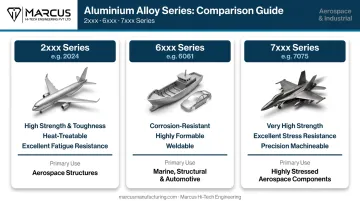
Aluminum is lighter than steel, naturally corrosion-resistant, and when alloyed, achieves some of the highest strength-to-weight ratios available in structural metals. The most commonly forged alloy series include:
- 2xxx series (e.g., 2024): High strength and toughness; used in commercial and aerospace structures
- 6xxx series (e.g., 6061): Formable, corrosion-resistant; used in marine, structural, and automotive parts
- 7xxx series (e.g., 7075): Very high strength; preferred for highly stressed aerospace components
Three sectors drive US demand:
- Aerospace: FAA fatigue and damage-tolerance requirements under 14 CFR 25.571 push manufacturers toward forged aluminum's superior fracture resistance
- Automotive: NHTSA's 2024 CAFE final rule targets a projected combined fleet average of approximately 50.4 mpg by MY2031, intensifying lightweighting pressure
- Defense: ITAR-controlled forgings for military platforms require US-based, security-compliant suppliers
Top 10 Aluminum Forging Companies in the USA
Companies were selected based on aluminum-specific capabilities, industry certifications, sectors served, forging method diversity, and market reputation. Primary-source aluminum forging capability was verified for Anchor Harvey, Scot Forge, Weber Metals, and Ellwood Closed Die Group. For remaining entries, independently verify current aluminum scope before procurement decisions.
1. Alcoa Corporation
Background: Alcoa traces its roots to 1888 and remains one of the most recognized names in aluminum. Historically a major aerospace-grade forging producer, Alcoa separated its fabricated products — including forgings — into a new entity, Arconic, in 2016.
The current Alcoa Corporation focuses on upstream aluminum production. Buyers seeking forged structural aerospace components originally associated with Alcoa should evaluate Howmet Aerospace (the successor to Arconic's aerospace business) for current forging programs.
Differentiators:
- Decades of proprietary aluminum alloy development across aerospace-grade material grades
- Vertically integrated supply from raw alumina through to finished metal products
- Deep established relationships across the aerospace and defense supply chain
Industries Served: Aerospace, automotive, defense, commercial transportation Forging Capabilities: Historically: closed-die and open-die structural aluminum forgings Certifications / Standards: Verify current certifications directly — forging scope transferred to Arconic/Howmet in 2016
2. Anchor Harvey Components
Background: Anchor Harvey is a dedicated aluminum forging specialist headquartered in Freeport, Illinois, with its forging facility established in 1978. They focus exclusively on precision closed-die aluminum forgings, backed by in-house CNC machining and heat treatment — all under one roof.
Differentiators:
- End-to-end capability: forging, heat treatment, and CNC machining without outsourcing
- Certified under AS9100, ISO 9001, and CQI-9 (heat treat system assessment)
- Active in motorsports, aerospace, specialty automotive, and fluid power sectors
- Formed an EV workgroup in 2021 targeting forged steering knuckles, control arms, and suspension components
Industries Served: Aerospace, specialty automotive, motorsports, fluid power, energy Forging Capabilities: Closed-die aluminum forging, CNC machining, heat treatment Certifications / Standards: AS9100, ISO 9001, CQI-9
3. Scot Forge
Background: Founded in 1893 and 100% employee-owned, Scot Forge is based in Spring Grove, Illinois. They are one of the strongest verified US aluminum forging suppliers, with documented capability across open-die and seamless rolled-ring aluminum forgings.
Differentiators:
- Verified aluminum alloy range: 1100, 2014, 2618, 3003, 5083, 6061, and 7079
- Certifications confirmed: ISO 9001:2015, AS9100D, and Nadcap accreditation for heat treatment and NDT
- Proven supply chain involvement in aerospace, defense, nuclear, and shipbuilding
- Computer-controlled forging presses ensure dimensional consistency on large cross-section forgings
Industries Served: Aerospace, defense, energy, shipbuilding, nuclear Forging Capabilities: Open-die forging, seamless rolled-ring forging, custom shapes and profiles Certifications / Standards: ISO 9001:2015, AS9100D, Nadcap (heat treatment, NDT)
4. Weber Metals (Otto Fuchs Group)
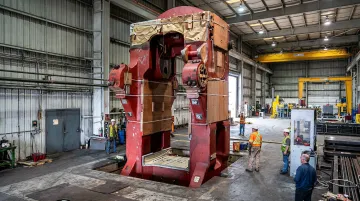
Background: Weber Metals, based in Paramount, California, is a subsidiary of Germany's Otto Fuchs Group. With press capacity ranging from 1,500 to 60,000 tons, they operate some of the largest aluminum forging presses in North America, producing large structural aerospace forgings.
Differentiators:
- Press capacity from 1,500 to 60,000 tons — among the widest ranges available in North American aluminum forging
- Full certification suite confirmed: AS9100D/ISO 9001:2015, ISO 14001:2015, and Nadcap accreditation for heat treatment, NDT, and materials testing
- Capabilities include closed-die, open-die, and ring rolling
- Primarily serves aerospace and defense structural applications
Industries Served: Aerospace, defense, commercial aviation Forging Capabilities: Large closed-die aluminum forging, open-die forging, ring rolling, structural aerospace components Certifications / Standards: AS9100D, ISO 9001:2015, ISO 14001:2015, Nadcap (heat treatment, NDT, materials testing)
5. Precision Castparts Corp (PCC Forged Products)
Background: Precision Castparts Corp is a large US-based aerospace and industrial component manufacturer with forging divisions supplying safety-critical components for aircraft engines, airframes, and power generation. PCC Forged Products operates multiple US facilities focused on high-integrity forgings.
Differentiators:
- Maintains strict quality traceability systems and concurrent engineering support across forging programs
- Deep procurement relationships with major aerospace primes
- Forging divisions primarily cover nickel, titanium, and steel — confirm aluminum alloy availability directly before shortlisting
Industries Served: Aerospace, power generation, industrial gas turbines Forging Capabilities: Closed-die precision forgings, high-temperature and structural applications Certifications / Standards: Verify AS9100 and Nadcap accreditation for specific sites and alloy scopes
6. Ellwood Closed Die Group
Background: Part of the broader Ellwood Group — a Pennsylvania-based private manufacturer with deep roots in forging and engineered metals — the Ellwood Closed Die Group (ECDG) is the relevant operating unit for buyers seeking aluminum forgings. ECDG explicitly lists closed-die aluminum forgings in the 25–8,000 lb range.
Differentiators:
- Both closed-die plants hold AS9100D, ISO 9001:2015, and Nadcap certification
- Serves aerospace, defense, energy, and industrial machinery sectors
- Part of a multi-unit group with in-house heat treatment and metallurgical testing
- Broad material range with confirmed aluminum scope at the closed-die division
Industries Served: Aerospace, defense, energy, industrial machinery Forging Capabilities: Closed-die aluminum forging (25–8,000 lb), heat treatment Certifications / Standards: AS9100D, ISO 9001:2015, Nadcap
7. ATI Forged Products
Background: ATI Forged Products is a division of ATI Inc. (formerly Allegheny Technologies), specializing in high-performance forgings for aerospace and defense applications from multiple US facilities. ATI's forging expertise centers on titanium, nickel superalloys, and specialty steels.
Differentiators:
- Advanced forging simulation tools and strict aerospace qualification processes
- Nadcap accreditation for relevant process scopes
- Primary documented materials are titanium and specialty alloys — confirm aluminum availability directly before specifying
Industries Served: Aerospace, defense Forging Capabilities: Closed-die precision forgings, high-performance alloy expertise Certifications / Standards: AS9100, ISO 9001, Nadcap (verify site-specific scopes)
8. Aichi Forge USA
Background: Aichi Forge USA, located in Georgetown, Kentucky, is a subsidiary of Japan's Aichi Steel Corporation, established in 2009. They operate high-volume impression-die forging using 4,000, 6,000, and 8,000-ton mechanical presses for automotive drivetrain and chassis components.
Differentiators:
- High-volume throughput with strict dimensional tolerances aligned to Tier 1 automotive requirements
- Press sizes of 4,000, 6,000, and 8,000 tons support large automotive structural components
- Primary documented materials are carbon, alloy, and micro-alloy steel — verify aluminum alloy availability directly
Industries Served: Automotive (OEM and Tier 1 supplier) Forging Capabilities: Impression-die forging, high-volume mechanical press forging, drivetrain and chassis components Certifications / Standards: Verify IATF 16949 and current quality certifications directly
9. Forge USA
Background: Forge USA is a US-based forging company associated with oil and gas, aerospace, and marine sectors, known for closed-die forgings and integrated machining for tight-tolerance components.
Differentiators:
- In-house machining supports complete part delivery on tight-tolerance components
- Track record with safety-critical oil and gas applications
- Note: Primary-source documentation was limited during research — verify current operational status, aluminum scope, and certifications before engaging
Industries Served: Oil and gas, aerospace, marine, industrial Forging Capabilities: Closed-die forging, CNC machining, large component forgings Certifications / Standards: Verify ISO 9001 and sector-specific certifications directly
10. Canton Drop Forge
Background: Founded in 1903 and based in Canton, Ohio, Canton Drop Forge has over 120 years of closed-die forging history. They supply forged components to automotive, railroad, military, and heavy equipment sectors, with in-house heat treatment capability.
Differentiators:
- Long-standing defense procurement record spanning over a century of operation
- Handles both high-volume and custom production runs with in-house heat treatment
- Primary documented materials are steel, stainless steel, and superalloys — confirm aluminum capability directly before specifying
Industries Served: Automotive, military/defense, railroad, heavy equipment Forging Capabilities: Closed-die forging, heat treatment, custom and volume production Certifications / Standards: ISO 9001:2015, Nadcap (verify current scopes)
How to Choose the Best Aluminum Forging Company
The Selection Framework
Not all forging companies are aluminum forging companies. The most common buyer mistake is shortlisting based on general forging reputation without confirming aluminum-specific capability, alloy range, and current certifications.
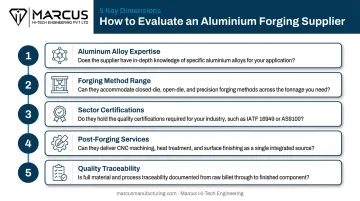
Evaluate suppliers across these five dimensions:
- Aluminum alloy expertise — Does the supplier explicitly work with your required alloy (6061, 7075, 2024)? Ask for past program references.
- Forging method range — Closed-die for complex, repeatable geometries; open-die for large sections; rolled ring for flanges and rings. Match the method to your part.
- Certifications relevant to your sector — AS9100 and Nadcap for aerospace; IATF 16949 for automotive; ISO 9001 as a baseline. ITAR registration is a legal requirement for defense forgings, not a quality credential.
- Post-forging services — In-house machining, heat treatment, and surface finishing affect total lead time and cost of ownership.
- Quality traceability — Can the supplier provide dimensional reports, material certifications, and PPAP documentation? Process control at the forging stage prevents rework downstream.
What Separates a Supplier from a Partner
Press capacity and brand size matter less than operational reliability. Before committing to a long-term supplier relationship, assess:
- On-time delivery rates across comparable programs
- First-article inspection pass rates
- Responsiveness to engineering changes during program ramp-up
- Scalability — can the supplier handle a 3× volume increase without lead time collapse?
Many aluminum component programs also require precision die cast or CNC-machined parts alongside forgings. For buyers managing that broader supply chain, Marcus Hi-Tech Engineering is an IATF 16949:2016 and ISO 9001 certified manufacturer with 45+ years of experience. Their in-house capabilities span die casting, CNC machining, surface finishing, and assembly, with direct-to-warehouse shipping to North America. APQP, PPAP, and FAIR programme management are handled in-house, reducing qualification burden for automotive and aerospace OEMs.
Conclusion
The right aluminum forging company aligns with your industry's regulatory requirements, alloy specifications, quality systems, and production scalability — not just the size of their press. The companies on this list represent a broad spectrum of capability, from large-scale aerospace structural forging to high-volume automotive closed-die production.
Before finalizing any supplier, establish ongoing performance benchmarks. These metrics reveal more about fit than certifications alone:
- On-time delivery rates across production and sample phases
- First-article pass rates and PPAP acceptance timelines
- Engineering change responsiveness and lead-time flexibility
- Non-conformance rates and corrective action turnaround
If your program also requires precision die cast or CNC-machined aluminum components alongside forged parts, Marcus Hi-Tech Engineering offers a vertically integrated solution — 45+ years of manufacturing experience, IATF 16949:2016 certification, and direct-to-warehouse shipping to North America. Reach out to discuss your component requirements.
Frequently Asked Questions
What is the best aluminum alloy for forging?
6061 and 7075 are the most commonly forged aluminum alloys. 6061 offers good corrosion resistance and weldability for structural and marine applications, while 7075 delivers higher strength-to-weight performance suited to aerospace and high-stress components (UTS 572 MPa vs 6061's 310 MPa). 2024 is another aerospace-grade option valued for its toughness and fatigue resistance.
What are the 4 types of forging?
The four primary methods are:
- Open-die forging: large or simple shapes worked between flat dies
- Closed-die/impression-die forging: metal pressed into a shaped cavity for complex, repeatable parts
- Rolled ring forging: produces seamless rings and flanges
- Cold forging: performed near room temperature for tight tolerances and surface finish
Aluminum is most commonly processed using closed-die and open-die methods.
What is aluminum forging used for?
Aluminum forgings appear in aerospace structural components (bulkheads, wing spars, fuselage frames), automotive drivetrain and suspension parts (control arms, steering knuckles), defense hardware, marine fittings, and EV structural components — anywhere a high strength-to-weight ratio and fatigue resistance are required.
How do I choose an aluminum forging company in the USA?
Evaluate aluminum-specific alloy experience, forging method range, relevant certifications (AS9100 for aerospace, IATF 16949 for automotive), post-forging capabilities (machining, heat treatment), and past program references in your target industry. Confirm capability at the specific plant, not just at the parent company level.
What certifications should an aluminum forging company have?
Requirements vary by sector: AS9100 and Nadcap for aerospace, IATF 16949 for automotive, and ISO 9001 as a quality baseline across industries. For defense-related forgings in the US, ITAR registration is a legal regulatory requirement, not a quality certification.
What is the difference between aluminum forging and aluminum casting?
Forging compresses solid aluminum billets under high force, producing parts with aligned grain structure, superior fatigue resistance, and fewer internal defects. Casting pours molten aluminum into a mold, which can introduce porosity and lower mechanical strength — making forged parts the choice for safety-critical, high-load applications.