Introduction
Choosing the wrong zinc die casting supplier doesn't just affect part quality — it disrupts your entire production schedule. For procurement engineers and OEM buyers sourcing connectors, housings, and hardware components, supplier selection directly determines scrap rates, tooling longevity, and whether your supply chain holds up under volume pressure.
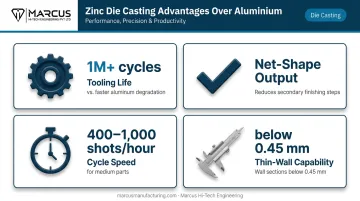
Zinc alloys support wall sections below 0.45 mm, tooling life routinely exceeds one million parts, and cycle rates reach 400–1,000 shots per hour for medium-sized components. Those are benchmarks aluminum cannot match at equivalent tooling cost — which is why zinc remains the material of choice for high-volume precision hardware.
This guide covers 10 zinc die casting companies serving US OEMs, evaluated on process capability, certifications, secondary operations integration, and industry track record. One entry — Marcus Hi-Tech Engineering — is a certified global manufacturing partner with an active North American client base, included for buyers exploring offshore supply chain diversification without sacrificing quality or compliance.
Key Takeaways
- Zinc die casting offers superior tooling life, thin-wall capability, and fast cycle times versus aluminum
- Top US suppliers differentiate on alloy expertise, in-house tooling control, and secondary operations integration
- IATF 16949 and ISO 9001 certification are baseline requirements for automotive and regulated-sector programs
- Zamak 3 and Zamak 5 dominate North American production volumes; ZA alloys handle higher-strength applications where standard Zamak grades fall short
- IATF-certified global manufacturers deliver US OEM-compliant quality with 20–40% lower per-part cost than domestic-only sourcing
Zinc Die Casting in the USA: A Brief Overview
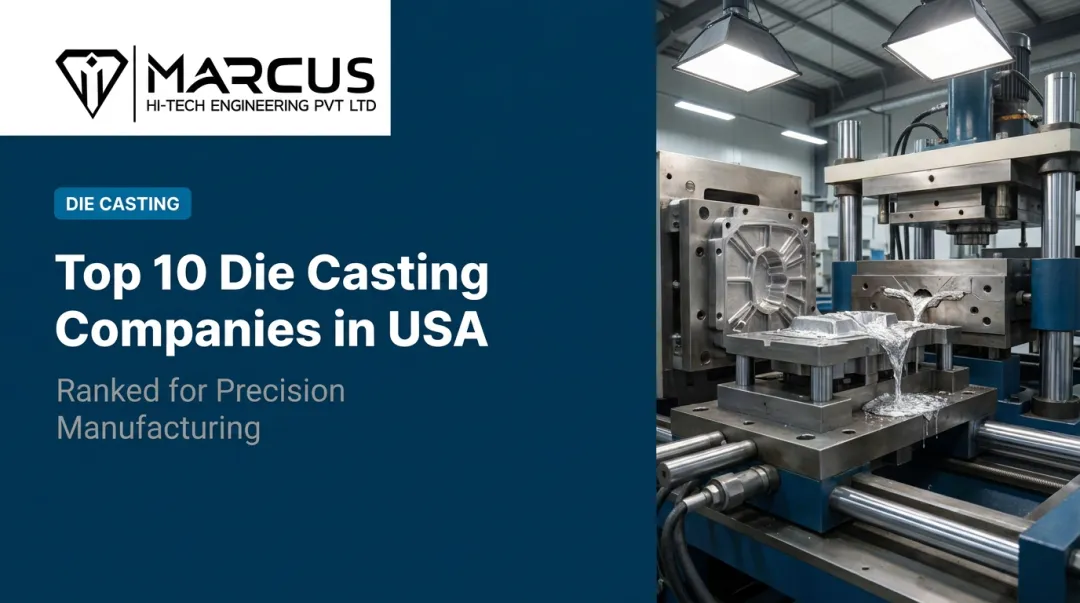
Zinc die casting injects molten zinc alloy into hardened steel dies under high pressure, producing net-shape components with tight dimensional tolerances and smooth, platable surface finish. For US manufacturers, it's the go-to process for connectors, hardware housings, and precision fittings — where repeatability and surface quality outweigh raw material cost.
The automotive-parts zinc die casting market is projected to grow at 3.0% CAGR through 2030, with electronics, consumer goods, and industrial equipment all contributing to steady demand. Governing this supply base, the North American Die Casting Association (diecasting.org) publishes the product specifications and die-steel standards most US buyers reference during sourcing.
Key zinc-specific advantages over aluminum:
- Dies routinely exceed 1 million cycles — aluminum tooling degrades faster at higher casting temperatures
- Net-shape output reduces secondary finishing steps and post-processing cost
- Cycle rates of 400–1,000 shots per hour for medium-sized components
- Zamak 7 and similar high-fluidity alloys enable wall sections below 0.45 mm
Top 10 Zinc Die Casting Companies in the USA
Selection criteria used for this ranking:
- Zinc-specific process capability and alloy range
- In-house tooling design and control
- Secondary operations integration (machining, finishing, assembly)
- Quality certifications (IATF 16949, ISO 9001, and equivalents)
- Documented OEM and Tier-1 supply track record
1. Dynacast
Headquarters: Yorktown, Virginia | Industries: Electronics, Medical, Automotive, Hardware
Dynacast is the global benchmark for precision zinc die casting. Its proprietary multi-slide technology — supporting up to six perpendicular slides — enables complex geometries with fewer secondary operations, running at 5–15 cycles per minute. This makes Dynacast the go-to for high-volume miniature component programs where dimensional repeatability is non-negotiable.
| Attribute | Details |
|---|---|
| Zinc Alloys | Zamak 2, 3, 5, 7, 8; ACuZinc5, EZAC, ZA-27 |
| Certifications | IATF 16949:2016, ISO 9001:2015, ISO 14001:2015, ISO 27001:2022, ISO 45001:2018 |
| Secondary Ops | Subassembly, overmolding, insert molding |
2. Pace Industries
Headquarters: Novi, Michigan (founded 1970 in Harrison, AR) | Industries: Automotive, Commercial Vehicle, Powersports, Aerospace, Medical
One of North America's largest custom die casting organizations, Pace operates 18 facilities across the US and Mexico. Its full-service scope — in-house tooling design, multi-slide and conventional casting, CNC machining, plating, and assembly — reduces supply chain handoffs for complex OEM programs.
| Attribute | Details |
|---|---|
| Zinc Alloys | Zamak 2, 3, 5, 7; ZA-8, ZA-12, ZA-27 |
| Certifications | IATF 16949:2016, ISO 9001:2015, ISO 14001:2015 |
| Secondary Ops | Machining, assembly, finishing |
3. A&B Die Casting
Headquarters: Hercules, California | Industries: Medical, Scientific Instruments, Automotive, Electronics, Lighting
With over 70 years of operation, A&B Die Casting focuses on low-to-medium volume zinc and aluminum programs. Machine range spans 200–900 tons. Strong option for buyers who need production flexibility — prototyping through mid-volume runs — without sacrificing consistency.
| Attribute | Details |
|---|---|
| Zinc Alloys | Zinc and aluminum alloys (specific grades not publicly confirmed) |
| Certifications | ISO 9001:2015 (certificate validity not publicly confirmed) |
| Secondary Ops | Machining, finishing, assembly, paint, plating, powder coating |
4. Carteret Die Casting Corporation
Headquarters: Somerset, New Jersey | Founded: 1960 | Industries: Industrial, Hardware, Consumer Products
Carteret specializes exclusively in zinc die casting, making it one of the few US shops with deep, zinc-only institutional knowledge. Its engineering team is a valuable resource for DFM input and tooling design on new zinc programs. ISO 9001:2015 certified with a current certificate valid through December 2026.
| Attribute | Details |
|---|---|
| Zinc Alloys | Zamak alloys (zinc-focused; specific grades not publicly confirmed) |
| Certifications | ISO 9001:2015 (cert. valid Dec. 2023–Dec. 2026) |
| Secondary Ops | Finished assemblies, large and small quantities |
5. Empire Die Casting
Headquarters: Macedonia, Ohio | Founded: 1947 | Industries: Automotive, Medical, Oil & Gas, Locomotive
Empire operates from a 200,000+ sq. ft. facility with die casting machines configured for varied part sizes and a wide range of industries. Current IATF 16949 and ISO 9001 certificates run through 2027. A strong domestic option for buyers needing high-capacity, multi-industry supply.
| Attribute | Details |
|---|---|
| Zinc Alloys | Zinc and aluminum alloys (specific grades not publicly confirmed) |
| Certifications | IATF 16949, ISO 9001 (certificates labeled 2024–2027) |
| Secondary Ops | CNC machining, finishing |
6. DyCast Specialties Corp
Headquarters: Starbuck, Minnesota | Industries: Medical, Commercial, Industrial
DyCast offers complete program support from prototyping and tooling through assembly, machining, and surface finishing — including annealing, coating, plating, and painting. Best fit for buyers who want a compact, full-service partner capable of managing the entire production cycle without multiple vendor relationships.
| Attribute | Details |
|---|---|
| Zinc Alloys | Zinc and aluminum alloys (specific grades not publicly confirmed) |
| Certifications | ISO 9001:2015 (certificate validity not publicly confirmed) |
| Secondary Ops | Design, tooling, die casting, precision machining, finishing, assembly |
7. Apex Aluminum Die Casting Company
Headquarters: Piqua, Ohio | Founded: 1980 | Industries: Industrial, Automotive, Consumer
Apex runs 14 custom-built manual and automated die cast machines, each with its own dedicated furnace. This independent furnace configuration enables rapid changeover and flexibility across varied part geometries — making Apex a practical choice for buyers with mixed or seasonal volume requirements.
| Attribute | Details |
|---|---|
| Zinc Alloys | Zinc and aluminum alloys (specific grades not publicly confirmed) |
| Certifications | References ISO 9001; current certificate not publicly confirmed |
| Secondary Ops | High-mix, low-volume production; finishing capabilities |
8. Cascade Die Casting Group
Founded: 1978 | US Operations: Atlantic, Great Lakes, Mid State divisions | Industries: OEM Manufacturing, Industrial, Consumer
Cascade integrates zinc and aluminum casting with secondary operations across its multi-facility US footprint. All facilities claim IATF 16949 certification. Zinc machine range spans 600–1,000 tons; alloys include Zamak 3, Zamak 5, and ZA-8. Secondary operations include automated trimming, 5-axis CNC, drilling, and tapping.
| Attribute | Details |
|---|---|
| Zinc Alloys | Zamak 3, Zamak 5, ZA-8 |
| Certifications | IATF 16949 (all facilities; current dates not publicly confirmed) |
| Secondary Ops | Automated trimming, 5-axis CNC, drilling, tapping |
Mid-Tier Domestic Supplier Comparison
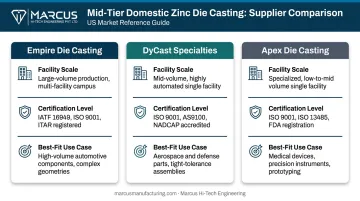
For buyers weighing mid-tier domestic suppliers, here's how these three compare on key selection factors:
| Criteria | Empire Die Casting | DyCast Specialties | Apex Die Casting |
|---|---|---|---|
| Facility Scale | 200,000+ sq. ft. | Compact, full-service | 14 machines, flexible |
| Certification | IATF 16949, ISO 9001 | ISO 9001 | ISO 9001 (unconfirmed) |
| Best For | High-capacity, multi-industry | Full-cycle single vendor | High-mix, seasonal volume |
9. Marcus Hi-Tech Engineering — Global Partner Serving North America
Headquarters: Coimbatore, India | Founded: 1981 | Industries: Automotive, EV, Electronics, Aerospace, Industrial, Healthcare, Energy
Marcus Hi-Tech Engineering has operated for 45+ years, with die casting machines spanning 40T to 2,500T and integrated in-house CNC machining (3/4/5-axis VMC, Turn-Mill, VTL). IATF 16949:2016 and ISO 9001 certified, with APQP, PPAP, FAIR, and DFM processes embedded across all programs.
Its in-house tool room designs and builds dies internally, with a documented 4–6 week tooling lead time and 1-week FAIR turnaround. CMM and advanced metrology ensure dimensional compliance before shipment. US buyers evaluating global supply chain options for cost-competitive zinc die casting will find Marcus a capable, process-mature alternative.
| Attribute | Details |
|---|---|
| Zinc Alloys | Zinc alloys, aluminum, magnesium, and multi-material assemblies |
| Certifications | IATF 16949:2016, ISO 9001 |
| Secondary Ops | 3/4/5-axis CNC machining, VMC, Turn-Mill, VTL, surface finishing, electro-mechanical assembly |
How to Evaluate a Zinc Die Casting Supplier
Process Capability and Tooling Control
The foundation of any supplier assessment starts here. For zinc programs, confirm:
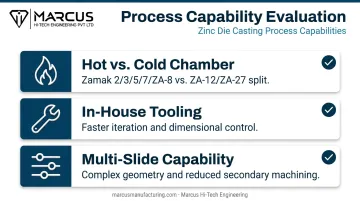
- Hot chamber vs. cold chamber capability: Hot chamber is standard for Zamak 2, 3, 5, 7, and ZA-8 due to fast cycle requirements. Cold chamber is required for ZA-12 and ZA-27.
- In-house tooling: Suppliers who design and build dies internally have faster iteration cycles and tighter control over dimensional consistency. Outsourced tooling adds risk.
- Multi-slide capability: For complex geometries requiring features on multiple faces, multi-slide technology reduces secondary machining — a meaningful cost driver on high-volume programs.
Quality System Readiness
IATF 16949:2016 is the baseline requirement for automotive-tier zinc programs. PPAP capability — including control plans, process flow diagrams, capability studies (Cpk/Ppk), and MSA — demonstrates a supplier's ability to manage production part approval for OEM customers. ISO 9001 is the minimum standard for non-automotive programs.
Beyond certification logos, look for:
- CMM inspection with documented dimensional reporting
- Inline process controls during production runs
- Formal APQP engagement at program launch, not just at PPAP submission
Supply Stability and Scale Compatibility
Quality credentials alone don't guarantee delivery performance. Unit price is rarely the most important number — scrap rates, tooling maintenance quality, and lead-time reliability typically have a larger impact on total program economics than the quoted piece price.
Key supply stability checks:
- Machine tonnage range vs. your part's projected area requirements
- Single-site vs. multi-site operations (geographic risk)
- How the supplier handles tooling maintenance and peak demand periods
- Contingency planning for tooling failure or machine downtime
Suppliers who can address these points with documented processes — not just verbal assurances — are the ones equipped to sustain program performance at scale.
Conclusion
The right zinc die casting supplier does more than quote a competitive piece price. It aligns with your program's quality requirements, scales with your volume trajectory, and integrates the secondary operations you'd otherwise manage across multiple vendors.
For programs in automotive, medical, or industrial equipment, evaluate certifications and PPAP readiness before awarding production. Tooling control, process fit, and supply stability determine long-term program success. The opening quote rarely tells the full story.
Marcus Hi-Tech Engineering is an IATF 16949:2016 certified manufacturer with 45+ years of experience in zinc die casting — covering in-house tooling, casting, CNC machining, surface finishing, and assembly under one roof. If your program needs a certified global partner with direct-to-warehouse shipping to the US, contact Marcus to walk through your specifications.
Frequently Asked Questions
What is zinc die casting primarily used for?
Zinc die casting produces complex, thin-walled precision components for automotive hardware, electronic connectors, consumer product housings, and industrial fittings. The process is favored where high dimensional accuracy, good surface finish, and fast cycle times are all required simultaneously.
What zinc alloys are most commonly used in die casting?
The Zamak family (Zamak 2, 3, 5, and 7) dominates North American volumes — Zamak 3 is the general-purpose baseline, while Zamak 5 adds strength and creep resistance. ZA-8, ZA-12, and ZA-27 handle higher-strength applications, with ZA-27 offering the best wear performance but requiring cold chamber processing.
What certifications should a zinc die casting supplier hold?
ISO 9001 is the minimum quality management standard. IATF 16949 is required for automotive-tier programs. PPAP and APQP readiness — including control plans, capability studies, and formal first-article documentation — indicate whether a supplier can manage OEM production part approval processes.
What is the difference between hot chamber and cold chamber die casting for zinc?
Hot chamber is standard for most Zamak alloys (Zamak 2, 3, 5, 7) and ZA-8, supporting fast cycles and integrated metal handling. Cold chamber is required for ZA-12 and ZA-27, where higher aluminum content raises the melting point beyond hot chamber system limits.
How do I evaluate a zinc die casting supplier for an OEM program?
Assess in-house tooling capability, process fit (hot/cold chamber, multi-slide), quality certifications, and secondary operations integration. Site audits or formal capability assessments are strongly recommended before awarding production — also evaluate tooling maintenance practices, peak demand capacity, and program ramp-up history.
Can offshore zinc die casting partners reliably serve US manufacturers?
Yes — certified offshore partners holding IATF 16949 and ISO 9001, with CMM inspection, inline quality controls, and direct-to-warehouse shipping, can reliably support US programs. Many US OEMs use certified global partners specifically to reduce per-part cost while maintaining quality compliance.