Introduction
Sourcing the wrong die casting partner costs more than a rejected shipment — it means delayed product launches, quality escapes, and supply chain exposure that's hard to recover from. Automotive OEMs, EV manufacturers, aerospace primes, and electronics brands all depend on precision die cast components produced at scale.
The process relies on high-pressure injection of molten metal into hardened steel dies, producing complex, near-net-shape parts with tight tolerances and repeatable quality.
The US aluminum die casting market alone is valued at $10.49 billion in 2025, according to Grand View Research, and the sector supports over 50,000 jobs across the country. With hundreds of suppliers competing for contracts, choosing the wrong die casting partner means quality escapes, delayed launches, and supply chain disruption.
The 10 companies profiled here were evaluated on alloy capabilities, machine capacity, certifications, industry track record, and post-casting service depth. Procurement teams and design engineers will find a reliable starting point for supplier shortlisting.
Key Takeaways
- The US aluminum die casting market is valued at $10.49B in 2025, with EV components driving the fastest growth at a 9.65% CAGR
- Aluminum dominates US die casting with 57% market share; magnesium is the fastest-growing alloy segment
- IATF 16949:2016 and ISO 9001 certifications are non-negotiable for automotive and regulated-industry sourcing
- Machine tonnage range (look for 60T–2,500T coverage) and multi-alloy capability are stronger fit indicators than company age or size
- IATF-certified offshore suppliers with direct-to-warehouse shipping give US buyers a viable path to cut costs and lead times without sacrificing quality standards
Die Casting in US Manufacturing: What You Need to Know
Die casting is a high-pressure metal forming process where molten metal is injected into reusable hardened steel dies at pressures ranging from hundreds to thousands of pounds per square inch. The result: complex, near-net-shape components with excellent surface finish and dimensional consistency, produced at volumes few other casting methods can match.
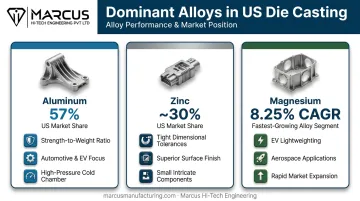
The dominant alloys in US die casting:
- Aluminum: 57% of the North American automotive die casting market; valued for its strength-to-weight ratio and thermal properties
- Zinc: Preferred for small, intricate parts requiring tight tolerances and good surface finish
- Magnesium: Fastest-growing segment at 8.25% CAGR through 2031, driven by lightweighting demands in EV and aerospace
Demand is concentrated in automotive (the largest sector, representing 83% of OEM demand), followed by EV/battery systems, aerospace, defense, electronics, and medical devices. North American market data from Mordor Intelligence puts the automotive die casting market at $12.68B in 2025, with sustained growth projected across all major segments.
The 10 companies below were evaluated for reliability, technological capability, certifications, and documented performance across these key sectors.
Top 10 Die Casting Companies in the USA
Companies were selected based on industry presence, alloy capabilities, certifications, production scale, and cross-sector customer trust — not simply by size or founding year.
Gibbs Die Casting
Gibbs Die Casting, headquartered in Henderson, Kentucky, is one of North America's largest high-pressure aluminum die casting suppliers. Founded in 1965, its primary focus is automotive OEM and Tier 1 programs: structural and safety-critical components where process control and engineering depth matter most.
Gibbs specializes in large, thin-walled aluminum castings: transmission cases, steering columns, engine brackets, and EV battery housings. The company's strength lies in its engineering support for complex, high-volume programs and plants in the US, Mexico, and Hungary.
| Category | Details |
|---|---|
| Materials / Alloys | High-pressure aluminum alloys (A380, A360, structural grades) |
| Key Capabilities | High-pressure die casting, structural castings, CNC machining, assembly |
| Certifications | IATF 16949:2016, ISO 14001 |
| Industries Served | Automotive, EV/Battery Systems, Defense |
Dynacast
Operating under the Form Technologies family, Dynacast is a global precision die casting manufacturer with 25 locations listed across North America, Europe, and Asia. The company is known for high-volume production of small, intricate metal parts where dimensional consistency across global plants is a hard requirement.
Dynacast's proprietary multi-slide die casting technology produces complex geometries that conventional two-slide dies cannot achieve, which makes it the preferred partner for miniaturized components in healthcare devices, electronics, and automotive sensors.
| Category | Details |
|---|---|
| Materials / Alloys | Zinc, aluminum, magnesium alloys |
| Key Capabilities | Precision die casting, multi-slide technology, finishing, assembly |
| Certifications | IATF 16949:2016, ISO 9001, ISO 14001, ISO 45001 |
| Industries Served | Automotive, healthcare, consumer electronics, defense |
Pace Industries
Founded in 1970 in Harrison, Arkansas, Pace Industries has grown into one of North America's largest die casting networks — now with 18 manufacturing facilities, over 4,000 associates, and a global headquarters relocated to Novi, Michigan in 2021.
Unlike single-alloy shops, Pace works across aluminum, zinc, and magnesium. Aluminum machines range from 400 to 3,000 tons, covering everything from small precision components to large structural parts. In-house tooling, engineering support, machining, and assembly complete the picture.
| Category | Details |
|---|---|
| Materials / Alloys | Aluminum, zinc, magnesium alloys |
| Key Capabilities | Die casting, tooling, CNC machining, engineering support, assembly |
| Industries Served | Automotive, medical, electrical, industrial |
Ryobi Die Casting (USA)
Part of Japan's Ryobi Group, Ryobi Die Casting USA operates from Shelbyville, Indiana, with 700+ employees producing complex aluminum structural castings for automotive customers. The parent company's global die casting network brings research-backed process engineering to US programs.
What distinguishes Ryobi is its vertically integrated model: in-house die design, process engineering, and R&D capability, from tooling through finished part. This depth makes it a strong partner for high-complexity, long-cycle automotive programs.
| Category | Details |
|---|---|
| Materials / Alloys | Aluminum alloys (automotive grades) |
| Key Capabilities | High-pressure die casting, die design, process engineering, R&D |
| Industries Served | Automotive |
Dura | Shiloh
MiddleGround Capital acquired the company in 2020; it now operates as Dura | Shiloh — an automotive-focused die casting and metal solutions supplier. Its positioning centers on lightweighting for both internal combustion engine and electric vehicle platforms.
Dura | Shiloh's strength is structural aluminum and magnesium castings for body-in-white, chassis, and powertrain applications, with a manufacturing base supporting both cast and stamped metal assemblies for global mobility programs.
| Category | Details |
|---|---|
| Materials / Alloys | Aluminum, magnesium alloys |
| Key Capabilities | Structural die casting, metal stamping, assembly |
| Industries Served | Automotive, EV, commercial vehicles |
Empire Die Casting
Empire Die Casting, founded in 1947 in Macedonia, Ohio, operates a 200,000+ square foot facility serving industries well beyond automotive, including medical, locomotive, and oil and gas.
That industry diversity is itself a differentiator. Empire's varied machine tonnages cover a wide range of part sizes, and its in-house machining and finishing capabilities reduce the number of downstream vendors a buyer needs to manage.
| Category | Details |
|---|---|
| Materials / Alloys | Aluminum, zinc alloys |
| Key Capabilities | High-pressure die casting, CNC machining, finishing |
| Certifications | IATF 16949:2016, ISO 9001:2015, ISO 14001:2015 |
| Industries Served | Automotive, medical, oil & gas, locomotive |
Cascade Die Casting Group
Privately held since 1978, Cascade Die Casting Group operates three US locations producing aluminum (alloys 380, 360, 413) and zinc (Zamak 3, 5, ZA8) die cast components across transportation, heavy truck, appliances, electronics, and consumer goods.
Cascade's long operational history and flexibility across both aluminum and zinc make it a practical choice for buyers needing a domestic partner with demonstrated production range rather than a single-sector specialist.
| Category | Details |
|---|---|
| Materials / Alloys | Aluminum (380/360/413), zinc (Zamak 3/5/ZA8) |
| Key Capabilities | Die casting, secondary machining, finishing |
| Industries Served | Automotive, heavy truck, appliances, electronics, consumer goods |
A&B Die Casting
Based in Hercules, California, A&B Die Casting has a long operational history in aluminum and zinc castings, with a particular focus on low-to-medium volume programs where customer-specific optimization matters more than pure throughput. The company holds ISO 9001:2015 certification and has documented experience in medical hardware, telecommunications, and architectural lighting.
A&B's value is adaptability — the ability to optimize part design and production approach for variable-volume customers who don't fit the high-volume mold.
| Category | Details |
|---|---|
| Materials / Alloys | Aluminum, zinc alloys |
| Key Capabilities | Die casting, machining, low-to-medium volume production |
| Certifications | ISO 9001:2015 |
| Industries Served | Automotive, electronics, industrial, medical, telecommunications |
DyCast Specialties Corp.
Based in Starbuck, Minnesota, DyCast Specialties operates as a full-service casting partner, offering aluminum and zinc HPDC alongside an unusually broad set of value-added operations handled in-house.
For buyers who need secondary operations without managing multiple vendors, DyCast's single-source model reduces supply chain complexity.
| Category | Details |
|---|---|
| Materials / Alloys | Zinc, aluminum alloys |
| Key Capabilities | Die casting, prototyping, tooling, machining, assembly, plating, coating, anodizing |
| Certifications | ISO 9001:2015 |
| Industries Served | Industrial, automotive, consumer goods |
Alumalloy Metalcasting Company
Based in Ohio, Alumalloy has built a reputation around permanent-mold and gravity casting of aluminum: complex engine components, transmission cases, and structural parts that challenge standard foundries. The company's niche is technically demanding parts that require proprietary techniques and process expertise to cast reliably.
Note: Alumalloy's documented capabilities center on permanent-mold and gravity casting. Buyers requiring high-pressure die casting (HPDC) should confirm process fit before shortlisting.
| Category | Details |
|---|---|
| Materials / Alloys | Aluminum alloys (specialty and structural grades) |
| Key Capabilities | Permanent-mold casting, CNC milling, complex casting techniques |
| Industries Served | Industrial, automotive, energy |
How We Chose the Best Die Casting Companies in the USA
This list was built against criteria that directly affect production outcomes. The most common buyer mistakes: selecting on price alone, skipping certification verification, or failing to confirm machine tonnage compatibility with their specific part size and alloy.
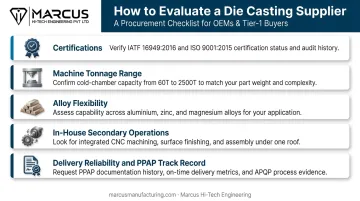
The evaluation criteria used:
- Certifications — IATF 16949:2016 for automotive programs; ISO 9001:2015 as the cross-industry baseline. Certificates are plant-specific — always request the certificate for the facility that will actually produce your parts
- Machine tonnage range — Directly determines the part sizes and projected shot weights a facility can handle
- Alloy flexibility — Aluminum, zinc, and magnesium each require different equipment and process parameters; multi-alloy capability matters for program flexibility
- In-house secondary operations — CNC machining, finishing, assembly, and tooling depth reduce vendor count and improve accountability
- Delivery reliability and PPAP track record — Particularly critical for regulated industries where first-article documentation and production approvals gate program launch
One supplier that checks all five criteria above — while offering significant cost advantages through India-based manufacturing — is Marcus Hi-Tech Engineering. IATF 16949:2016 and ISO 9001:2015 certified, Marcus runs die casting machines from 40T to 2,500T with in-house tooling, CNC machining, surface finishing, and assembly under one roof. APQP, PPAP, and FAIR documentation support is built into every program, serving automotive, EV, aerospace, and industrial customers shipping direct to US warehouses.
Conclusion
The right die casting partner is the one whose certifications, alloy capabilities, machine tonnage, and secondary service depth align with your part requirements, volume profile, and supply chain goals — not simply the largest name on the market.
Before shortlisting any supplier, evaluate:
- Confirm certifications are issued to the specific plant running your job, not a parent entity
- Verify documented experience with your exact alloy and casting method
- Assess post-casting depth — machining, finishing, assembly, and quality documentation under one roof reduces supply chain risk
- Confirm the supplier can scale as your program volumes change
- Require PPAP and FAIR compliance for automotive and aerospace programs — these are non-negotiable
The due diligence process starts with the right questions. For North American programs that require a globally certified manufacturing partner to reduce costs, shorten lead times, and simplify supply chain complexity, Marcus Hi-Tech Engineering offers consultations covering capability fit, DFM review, and program costing.
Frequently Asked Questions
What is the largest die casting company in the USA?
By production scale, Gibbs Die Casting and Pace Industries rank among the top. Gibbs leads in high-pressure aluminum automotive castings from its Henderson, Kentucky facility. Pace operates 18 manufacturing facilities across the US and Mexico with machines ranging from 400 to 3,000 tons.
What materials are most commonly used by die casting companies in the USA?
Aluminum dominates with 57% of the North American automotive die casting market, valued for its strength-to-weight ratio and thermal performance. Zinc is preferred for small, tight-tolerance components. Magnesium is the fastest-growing alloy — its die casting segment is expanding at 8.25% CAGR — driven by lightweighting demands in automotive and EV applications.
How do I choose the right die casting manufacturer for my project?
Start with certifications (IATF 16949:2016 for automotive, ISO 9001 for general industrial), then verify machine tonnage range against your part size, alloy capability, and whether the facility offers in-house machining and finishing. Confirm PPAP capability and request plant-specific certificates, not just corporate-level claims.
What certifications should a reliable die casting company hold?
IATF 16949:2016 signals that a facility can meet OEM process discipline, traceability, and quality requirements — not just that the parent company holds a certification. ISO 9001:2015 covers general industrial quality systems. A supplier holding both gives you documented evidence of control at the production level, not just a corporate policy statement.
What industries rely most on die casting manufacturers in the USA?
Automotive drives the largest share of US die casting demand. EV and battery systems, aerospace, electronics, medical devices, and industrial equipment follow. Of these, EV components are growing fastest — the segment carries a forecast 9.65% CAGR as manufacturers shift toward lightweight structural castings for battery enclosures and drivetrains.
What is the difference between hot chamber and cold chamber die casting?
Hot chamber die casting keeps the injection mechanism submerged in molten metal and is used for lower-melting-point alloys like zinc. Cold chamber die casting transfers metal separately from the furnace to the shot sleeve, making it suitable for aluminum and magnesium, which would damage a hot chamber system.