Introduction
US manufacturers face a compounding problem: supply chains are more complex, skilled labor is scarcer, and the cost of running in-house production keeps rising. Choosing the right turnkey manufacturing partner — one that covers everything from design review through final delivery — is one of the most critical sourcing decisions a business faces.
Demand for turnkey manufacturing has accelerated across automotive, aerospace, EV, electronics, and industrial sectors, driven by the need to compress lead times, reduce vendor fragmentation, and control costs.
According to MarketsandMarkets, the global EMS market is projected to grow from $648.51B in 2025 to $853.05B by 2030, reflecting how much production responsibility businesses are now offloading to specialist partners.
This article covers 10 turnkey manufacturing companies serving US customers, evaluated on end-to-end capabilities, quality certifications, industry experience, and supply chain reach.
Key Takeaways
- Turnkey manufacturing consolidates design, sourcing, fabrication, assembly, and delivery under one accountable partner
- The strongest partners hold IATF 16949, ISO 9001, AS9100, or ISO 13485 certifications relevant to your industry
- Process breadth across casting, machining, sheet metal, plastics, and assembly matters as much as company size
- Both US-domiciled manufacturers and global partners with established US service footprints appear on this list
- Evaluation should prioritize capability alignment and scalability over brand recognition alone
What Is Turnkey Manufacturing and Why US Businesses Rely on It
Turnkey manufacturing is a production model where a single manufacturer handles everything — design review, material sourcing, fabrication, assembly, quality control, and delivery — requiring minimal client involvement in day-to-day operations.
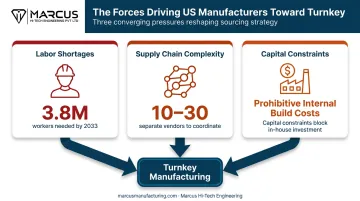
Three converging pressures are pushing US businesses toward this model:
- Labor shortages: NAM reports that US manufacturing may need 3.8M workers by 2033, with 1.9M jobs potentially unfilled — making in-house production expansion difficult to scale
- Supply chain complexity: Managing 10–30 separate vendors across casting, machining, finishing, and assembly creates coordination overhead and quality risk
- Capital constraints: Building internal capacity for every process is prohibitively expensive for most OEMs and Tier-1 suppliers
Automotive, aerospace, EV, healthcare, and industrial manufacturers all use this model for the same reason: consolidating vendors reduces risk and cuts lead times. The difference between a capable turnkey partner and a limited one comes down to process breadth, in-house versus subcontracted work, and whether their quality systems (IATF 16949, ISO 9001) hold up under audit. The companies below represent the strongest options available to US-based buyers.
Top 10 Turnkey Manufacturing Companies Serving the USA
These companies were shortlisted based on end-to-end manufacturing capabilities, quality certifications, multi-industry experience, scalable capacity, and demonstrated reliability for US-based customers.
1. Marcus Hi-Tech Engineering
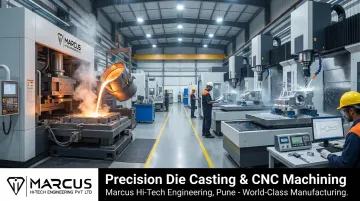
Marcus is a 45+ year-old global turnkey manufacturing partner headquartered in Coimbatore, India, with an established North American service footprint. The company specializes in die-cast components, CNC-machined parts, sheet metal, plastics, and electro-mechanical assemblies — covering the full production lifecycle for customers in automotive, aerospace, EV, electronics, healthcare, and industrial manufacturing.
Marcus holds both IATF 16949:2016 and ISO 9001 certifications and operates die casting machines from 40T to 2500T, supporting aluminium, zinc, and magnesium alloys. The in-house CNC machining shop runs 3/4/5-axis VMC, Turn-Mill, and VTL equipment, while a dedicated tool room handles die, mould, jig, and fixture design and fabrication.
Industry-standard quality processes — DFM, APQP, PPAP, and FAIR — are embedded throughout the program lifecycle. Inline CMM inspection reinforces dimensional accuracy at every stage.
Beyond in-house capabilities, Marcus coordinates a certified partner network spanning sheet metal stamping (up to 1000T), forgings (up to 4000T), extrusions, investment castings, sand castings, and plastic injection moulding (up to 3200T) — all managed by Marcus as single-source coordinator, not the customer.
| Industries Served | Automotive, EV, Aerospace, Electronics, Healthcare, Energy, Industrial Manufacturing |
| Key Capabilities | Die Casting (40T–2500T), CNC Machining (3/4/5 Axis), Sheet Metal, Plastics, Electro-Mechanical Assembly, Dedicated Tool Room |
| Certifications & Differentiators | IATF 16949:2016, ISO 9001; DFM, APQP, PPAP, FAIR; Inline CMM inspection; 45+ years of manufacturing excellence; global supply chain across India, Vietnam, and China |
2. Jabil Inc.
Founded in 1966 and headquartered in St. Petersburg, Florida, Jabil is one of the largest global EMS and turnkey manufacturing companies, with annual revenue of $29.8B, 140,000+ employees, and 100+ sites across 25+ countries. Its end-to-end services span engineering, manufacturing, and supply chain management.
Jabil's breadth across sectors and its integrated engineering-to-delivery model are its primary differentiators for US-based OEMs seeking a single accountable partner at scale.
| Industries Served | Healthcare, Automotive, Defense/Aerospace, Data Center, Industrial, Energy, Robotics, Semiconductor Equipment |
| Key Capabilities | Product design, electronics manufacturing, supply chain services, systems integration, global logistics |
| Certifications & Differentiators | AS9100D and ISO 9001:2015 controls documented; 100+ site global network; integrated engineering and supply chain |
3. Flex Ltd.
Founded in 1969, Flex is headquartered in Austin, Texas, with approximately 150,000 employees, 100+ facilities in ~30 countries, and annual revenue of $27.9B. US operations span Texas, Tennessee, California, New Hampshire, Illinois, and Ohio, among other locations.
Flex's verified differentiators include regional manufacturing flexibility, vertical integration across design and assembly, and global supply chain services — making it a strong fit for US OEMs managing complex, multi-region programs.
| Industries Served | Automotive, Healthcare, Industrial, Cloud/Data Center, Communications |
| Key Capabilities | Product design, electronics manufacturing, assembly, logistics, supply chain management |
| Certifications & Differentiators | ISO 9001, ISO 13485, and IATF 16949 referenced in supplier requirements (site-specific); vertical integration; ~49M sq. ft. of global manufacturing space |
4. Celestica Inc.
Headquartered in Toronto, Ontario, Celestica has annual revenue of $12.4B. Its US footprint includes facilities in Tucson, Richardson, Fremont, Maple Grove, Alpharetta, and Rochester. The Maple Grove, Minnesota location is certified to ISO 9001, AS9100, and ISO 13485, and is ITAR compliant and FDA registered.
Celestica stands out for complex electronics assembly and systems integration across regulated sectors, with a supply chain and fulfillment infrastructure suited to high-mix, high-complexity programs.
| Industries Served | Aerospace/Defense, Healthtech, Industrial, Communications, Enterprise, Capital Equipment, Energy, Semiconductor |
| Key Capabilities | Complex electronics assembly, systems integration, engineering services, commodity management, logistics and fulfillment |
| Certifications & Differentiators | ISO 9001, AS9100, ISO 13485 (Maple Grove); ITAR compliant; FDA registered; strong regulated-sector capability |
5. Plexus Corp.
Incorporated in 1979 and headquartered in Neenah, Wisconsin, Plexus has annual revenue of $4.03B. The company focuses on complex product realization across regulated industries, with concept-to-scaled-manufacturing support including Design for Excellence, manufacturing readiness assessments, and new product introduction (NPI) services.
At least one AS9100-certified design and manufacturing facility operates in each of Plexus's global regions, making it a credible partner for aerospace and defense programs.
| Industries Served | Healthcare/Life Sciences, Aerospace/Defense, Industrial, Semiconductor/Capital Equipment |
| Key Capabilities | NPI, Design for Excellence, manufacturing readiness assessment, electronics manufacturing, integrated test and inspection, supply chain services |
| Certifications & Differentiators | AS9100 certified (at least one facility per region); regulated-sector specialization; strong DFM and NPI capability |
6. Sanmina Corporation
Founded in 1980 in Silicon Valley and headquartered in San Jose, California, Sanmina has annual revenue of $8.1B with approximately 39,000 employees. The company's vertical integration depth — spanning PCB fabrication and assembly, cables, enclosures, and systems integration — is a primary differentiator for complex industrial and defense programs.
An internal case study documents a program with 1,200 parts and 130 suppliers achieving 10-day delivery through Sanmina's vertical integration (provider-reported, not independently benchmarked).
| Industries Served | Industrial, Medical, Defense/Aerospace, Automotive, Communications Networks, Cloud Infrastructure |
| Key Capabilities | PCB fabrication and assembly, cables, enclosures, systems integration, supply chain services |
| Certifications & Differentiators | ISO 13485, AS9100, IATF 16949, ISO 9001 (varies by site); deep vertical integration; strong medical and defense specialization |
7. Kimball Electronics
Founded in 1961 and headquartered in Jasper, Indiana, Kimball Electronics reported net sales of $1.487B. US operations include facilities in Jasper and Indianapolis. The company serves regulated sectors with a consistent quality infrastructure and electronics manufacturing services that span the full product lifecycle.
| Industries Served | Automotive, Medical, Industrial, Public Safety |
| Key Capabilities | Electronics manufacturing services, PCB assembly, supply chain management, testing, product lifecycle support |
| Certifications & Differentiators | ISO 9001, IATF 16949, ISO 13485 (facility-specific coverage); strong regulated-sector reliability; US-based manufacturing presence |
8. Integer Holdings Corporation
Headquartered in Plano, Texas, Integer reported sales of $1.854B. Integer is one of the largest medical device manufacturers globally, with ISO 13485:2016-certified facilities and FDA-registered locations. Its capabilities span design, component production, finished-device assembly, and regulatory support.
| Industries Served | Medical Devices (cardio/vascular, cardiac rhythm, advanced surgical, orthopedic, portable medical), Energy, Advanced Technologies |
| Key Capabilities | Medical device design and development, component manufacturing, finished-device assembly, regulatory compliance support |
| Certifications & Differentiators | ISO 13485:2016 certified facilities; FDA registered; end-to-end medical device program capability; highly regulated manufacturing expertise |
9. General Assembly & Manufacturing Corp. (GAMC)
Founded in 1977 and located in Cary, Illinois, GAMC is a US-based turnkey manufacturer focused on electromechanical assemblies, control panels, wire harnesses, and complete product builds. The company provides DfMA support, vendor and inventory management, and end-to-end assembly solutions. Named project relationships include ErgoTech, Promark Development, and Sage Medical.
| Industries Served | Medical, Aerospace, Defense, Industrial Automation, Energy |
| Key Capabilities | Electromechanical assembly, control panel builds, wire harnesses, potting, ultrasonic welding, vendor/inventory management |
| Certifications & Differentiators | ISO 9001:2015; DfMA support; US-based operations; complete product builds with customer-material quality review |
10. Sparton Corporation
Now operating under Elbit Systems of America following a completed acquisition in April 2021, Sparton is headquartered in De Leon Springs, Florida, with 1,000+ employees. The current business is a specialized defense-electronics manufacturer.
It is focused on anti-submarine and undersea-warfare systems, particularly sonobuoys. Its inclusion here is appropriate specifically for defense electronics programs requiring high-reliability manufacturing and ITAR compliance.
Note: Sparton divested its broader Manufacturing & Design Services business in 2020. Its current scope is defense-focused and should not be treated as a general-purpose EMS provider.
| Industries Served | Defense (anti-submarine warfare, undersea systems) |
| Key Capabilities | High-reliability defense electronics manufacturing, sonobuoy production, systems integration |
| Certifications & Differentiators | AS9100, ISO 9001, ITAR controls; deep defense specialization; high-reliability manufacturing for undersea applications |
How We Chose These Turnkey Manufacturing Companies
Many buyers shortlist manufacturers based on company size or brand recognition — overlooking process depth, certification relevance, and supply chain flexibility, which are the actual indicators of turnkey reliability.
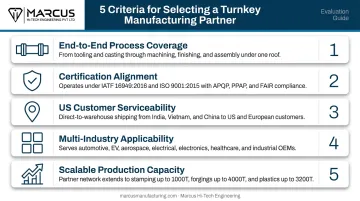
Core evaluation criteria:
- End-to-end process coverage — design support through delivery, not just fabrication
- Certification alignment — ISO 9001 as a baseline; IATF 16949 for automotive/EV; AS9100 for aerospace/defense; ISO 13485 for medical devices
- US customer serviceability — domestic facilities or established global-to-US service footprint
- Multi-industry applicability — capability across more than one sector reduces dependency risk
- Scalable production capacity — ability to grow from prototype volumes to full production runs
Each criterion ties directly to a measurable business outcome:
- IATF 16949 certification reduces automotive quality risk at the supplier level — not just on paper, but in production yield and warranty exposure
- APQP/PPAP capability catches design and tooling issues before they become costly commitments, accelerating new product launches
- A global supply network across India, Vietnam, and China cuts material costs and shortens lead times compared to single-region sourcing
Conclusion
The best turnkey manufacturing partnerships are built on capability alignment, certified quality systems, and transparent communication — not brand recognition alone. What matters in practice is whether a manufacturer can own the full production scope, maintain quality accountability across every stage, and scale with your program over time.
Before committing to a partner, evaluate on three practical dimensions:
- Scalability — can the manufacturer flex capacity as your production volumes change?
- Cost transparency — are quotes tied to verifiable process value, not just low headline numbers?
- Responsiveness — how quickly does the team engage on technical questions and qualification requirements?
For businesses in automotive, EV, aerospace, electronics, or industrial manufacturing seeking a proven global turnkey partner, Marcus Hi-Tech Engineering brings 45+ years of manufacturing experience, IATF 16949:2016 and ISO 9001 certifications, and end-to-end capability across die casting, CNC machining, surface finishing, and electro-mechanical assembly — all delivered through a single, accountable source. Contact us to discuss your project requirements.
Frequently Asked Questions
What is a turnkey manufacturer?
A turnkey manufacturer handles the complete production process — from design review and material sourcing through fabrication, assembly, quality control, and delivery. The client receives a finished product with a single point of contact and minimal day-to-day operational involvement.
What is the difference between turnkey manufacturing and contract manufacturing?
Traditional contract manufacturing often requires the client to manage sourcing and supply chain coordination independently. Turnkey manufacturing consolidates all production responsibilities — including procurement, manufacturing, and logistics — under one provider, cutting the client's coordination burden.
What certifications should a turnkey manufacturing partner hold?
Key certifications by industry: ISO 9001 (baseline quality), IATF 16949 (automotive/EV), AS9100 (aerospace/defense), and ISO 13485 (medical devices). Always verify current certificate status and confirm which specific facilities are covered before committing.
What industries benefit most from turnkey manufacturing?
Industries with complex assemblies, regulated quality requirements, or the need to scale production quickly benefit most — including automotive, EV, aerospace, electronics, medical devices, industrial equipment, and energy.
How do offshore turnkey manufacturers compare to US-based providers for American businesses?
Offshore turnkey partners — such as those based in India — can offer meaningful cost advantages while meeting US quality standards through certified processes and global supply chains. Verify certifications, check communication responsiveness, and confirm a track record with North American customers before committing.
How long does it typically take to transition to a turnkey manufacturing model?
Transition timelines depend on product complexity — simpler parts move faster, while assemblies requiring tooling development, supplier qualification, and first-article validation take much longer. Early DFM engagement at the design stage is the most effective way to compress this window.