What is the surface finishing process?
Surface finishing is the set of pre-treatment and coating steps used to improve a part’s appearance, corrosion resistance, wear performance, or adhesion. At Marcus, parts typically go through degreasing, acid cleaning, and conversion coating before processes such as powder coating, anodising, plating, blasting, polishing, or heat treatment. Finished parts are then verified through tests like salt spray, coating thickness, and adhesion checks.
What are the 5 types of metal finishing?
Five common metal finishing types are plating, anodising, powder coating, wet painting, and blasting or polishing. Each serves a different purpose. Plating improves corrosion resistance and appearance, anodising strengthens aluminium surfaces, powder coating adds durable protective colour, wet painting supports cosmetic finishes, and blasting or polishing prepares or refines the surface texture before final use.
What industries use mechanical part surface finishing and assembly services?
These services are widely used in automotive, aerospace, electronics, healthcare, energy, EV, and industrial manufacturing. Surface finishing protects parts from corrosion, wear, and environmental exposure, while assembly turns multiple components into ready-to-install sub-systems. Marcus supports these sectors with certified processes, inline inspection, and testing suited to both functional and aesthetic requirements.
How do I choose between anodising, plating, and powder coating?
The right process depends on the base material and the performance target. Anodising is ideal for aluminium when hardness and corrosion resistance matter. Plating works well for decorative finishes, conductivity, or uniform corrosion protection on complex geometries. Powder coating is often chosen for durable coloured finishes with strong impact and UV resistance. Material, environment, and appearance requirements should guide selection.
Can Marcus supply fully finished and assembled parts?
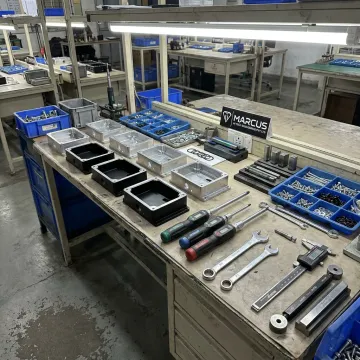
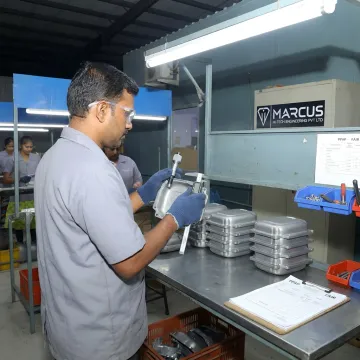
Yes. Marcus offers single-source supply by combining machining, surface finishing, and assembly capabilities. Customers can receive parts that are coated, plated, anodised, labelled, packaged, and assembled to specification rather than managing separate vendors. This reduces coordination effort, shortens lead times, and improves accountability because finishing quality, assembly fit, and final inspection are managed within one controlled workflow.
What quality standards are used for finishing and assembly?
Marcus operates under IATF 16949:2016 and ISO 9001 certified processes. Depending on the finishing method, verification can include ASTM B117 salt spray testing, XRF coating thickness checks, adhesion cross-hatch testing, inline inspection, electrical testing, and advanced metrology. Batch certificates are provided on shipments, helping customers maintain traceability and confidence in production consistency.
What materials can be finished and assembled?
Marcus supports a broad range of metallic and hybrid components, including aluminium, zinc, magnesium, machined parts, die-cast parts, stamped parts, forged parts, and assemblies that incorporate injection-moulded plastics. Process suitability varies by material. For example, anodising is used on aluminium, while plating and powder coating can support multiple metal substrates depending on the required finish and application.
Is this service suitable for prototypes and high-volume production?
Yes. Marcus supports both low-volume prototype work and high-volume OEM production. Semi-automated assembly lines, in-house finishing, and structured quality controls make it possible to scale from early validation builds to repeatable production runs. This is especially useful for manufacturers that want one partner capable of supporting development, process refinement, and ongoing supply without changing vendors.