Introduction
Automotive supply chains in the USA have become too complex — and too capital-intensive — for OEMs to manage entirely in-house. From die-cast powertrain housings to electro-mechanical assemblies, the trend is clear: outsource specialized production to certified partners who can deliver at scale, on time, and to IATF-grade quality standards.
MEMA reported in 2023 that suppliers now account for two-thirds of every vehicle's value — a figure that underscores just how much of the production ecosystem sits outside OEM factory walls.
Named EV programs make this concrete: Magna's GM Silverado EV battery enclosure award and AAM's Stellantis e-Beam axle contract both confirm that electrification is actively reshaping outsourcing decisions, well beyond traditional component sourcing.
What follows is a practical evaluation of the top 10 contract manufacturers currently serving US automotive OEMs — structured to help procurement teams compare capability breadth, certifications, production capacity, and program track record before committing to a sourcing partnership.
Key Takeaways
- Suppliers account for two-thirds of vehicle value — strategic outsourcing is standard practice across every major OEM
- IATF 16949:2016 certification is the non-negotiable baseline; verify it at the facility level, not just the corporate level
- Selection criteria must cover APQP/PPAP capability, DFM support, and scalability alongside unit price
- EV outsourcing is accelerating, with named programs at Magna, AAM, and others providing direct evidence
- Marcus Hi-Tech Engineering provides IATF 16949-certified die casting, CNC machining, and electro-mechanical assembly for North American OEMs
Overview of Contract Manufacturing in the Automotive Industry
Automotive contract manufacturing is the practice of outsourcing production of vehicle components, subassemblies, or complete systems to a third-party manufacturer who builds to the OEM's design and quality specifications while the OEM retains IP ownership.
The automotive operating environment sets this industry apart from most:
- Zero-defect expectations — tolerances and reliability standards leave no room for process drift
- Just-in-time delivery — supply disruptions cascade immediately into assembly line stoppages
- APQP/PPAP compliance — as defined by AIAG's Quality Core Tools framework, OEM customer-specific requirements supplement IATF 16949 with additional obligations
- Long-term scalability — programs span model lifecycles, requiring partners who can grow with production volumes
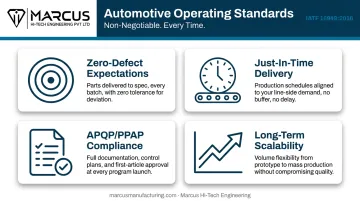
Meeting those standards is the baseline for any credible automotive supplier. The manufacturers listed below were evaluated on that basis — automotive certifications, manufacturing capability range, capacity to scale, and hands-on support for DFM, APQP, and PPAP processes.
Top 10 Contract Manufacturers in the USA for Automotive OEMs
1. Marcus Hi-Tech Engineering
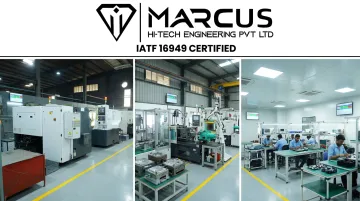
Founded in 1980 and operating for 45+ years, Marcus Hi-Tech Engineering is a manufacturing partner for automotive OEMs across North America, offering end-to-end solutions from a single, scalable ecosystem with a global footprint across India, Vietnam, and China. Capabilities span die casting, CNC machining, sheet metal, plastics, and electro-mechanical assemblies.
What sets Marcus apart is IATF 16949:2016 and ISO 9001 certification backed by a vertically integrated capability stack:
- Die casting from 40T to 2500T across hot and cold chamber processes
- CNC machining across 3-, 4-, and 5-axis VMC, Turn-Mill, and VTL configurations
- In-house tool room covering die, mold, jig, and fixture design with simulation capability
- Tooling lead times of 4–6 weeks with FAIR delivery within one week
Partner facilities extend capability to sheet metal stamping (up to 1000T), forgings (80T–4000T), investment castings, and plastic injection molding. All partner operations run under Marcus's unified IATF 16949-compliant QMS, with supplier audits, PPAP, and APQP applied uniformly.
| Attribute | Detail |
|---|---|
| Key Capabilities | Die casting (40T–2500T), 3/4/5-axis CNC machining, sheet metal, plastics, electro-mechanical assemblies, in-house surface finishing |
| Certifications | IATF 16949:2016, ISO 9001; APQP, PPAP, FAIR, and DFM-ready processes |
| Best For | North American OEMs seeking cost-competitive, quality-certified global manufacturing with single-source accountability |
2. Magna International
Magna is one of the world's largest automotive contract manufacturers, headquartered in Ontario, Canada, with extensive US operations. Its FY2025 revenue reached $42.0 billion, with over 170,000 employees across 341 manufacturing operations in 28 countries.
Magna's Steyr division assembles complete vehicles for OEMs — historically including the Mercedes-Benz G-Class, BMW Z4, and Toyota GR Supra at its Graz facility. On the EV side, GM awarded Magna the battery enclosure for the 2024 Chevrolet Silverado EV, with prior involvement in GMC Hummer EV and Ford F-150 Lightning programs confirming active electrification work.
| Attribute | Detail |
|---|---|
| Key Capabilities | Full vehicle assembly, body structures, seating, vision systems, powertrain components, EV battery enclosures |
| Certifications | IATF 16949 (facility-specific); group-wide coverage not fully disclosed |
| Best For | OEMs requiring large-scale, multi-system outsourcing including complete vehicle assembly |
3. Martinrea International
Martinrea is a leading North American manufacturer focused on metal forming, hydroforming, and fluid management systems. Its US footprint spans Michigan, Kentucky, Indiana, Mississippi, Alabama, and Oklahoma, with GM, Ford, Stellantis, BMW, and Toyota among its major OEM customers.
Martinrea's strength is in lightweight metal stampings and structural components — including battery trays, electric motor housings, subframes, and body-in-white structures — making it directly relevant to both ICE and EV platform programs.
| Attribute | Detail |
|---|---|
| Key Capabilities | Metal stamping, hydroforming, fluid management systems, BIW structures, EV battery trays, e-motor housings |
| Certifications | IATF 16949 confirmed at specific operations; verify current US site scope before shortlisting |
| Best For | OEMs requiring lightweight structural metal and fluid system components across mixed ICE/EV programs |
4. Flex Ltd.
Flex is a global contract manufacturer with dedicated automotive electronics capability. In 2022, it expanded its Jalisco, Mexico hub by 145,000 sq. ft. specifically for advanced electronics supporting electric and autonomous vehicles. Its 2025 Automotive News PACE awards covered the Jupiter compute platform and a backup DC/DC converter — confirming production-grade automotive electronics capability.
Flex bridges hardware manufacturing and intelligent systems, making it a natural fit for OEMs outsourcing electronics-heavy programs where mechanical and software integration meet.
| Attribute | Detail |
|---|---|
| Key Capabilities | Automotive compute platforms, EV power electronics, DC/DC converters, connected vehicle systems |
| Certifications | IATF 16949 status at specific Flex-operated sites — verify facility-level certificate and scope |
| Best For | OEMs outsourcing automotive compute, power electronics, and intelligent systems manufacturing |
5. Jabil Inc.
Jabil is a Fortune 500 contract manufacturer headquartered in St. Petersburg, Florida, with dedicated automotive and smart mobility programs. Its automotive page identifies telematics, sensors, optics, connectivity, high-power compute, and ASIL-certified design across an IATF-certified global footprint. In 2025, Jabil and AVL signed an MOU covering design and manufacturing for powertrain, compute, and driver-assistance technologies.
| Attribute | Detail |
|---|---|
| Key Capabilities | Telematics, sensors, automotive compute, ASIL-certified design, automated assembly, smart mobility systems |
| Certifications | IATF-certified global footprint stated; verify site-specific certificates for North American programs |
| Best For | OEMs accelerating EV, connected vehicle, or telematics manufacturing programs |
6. American Axle & Manufacturing (AAM)
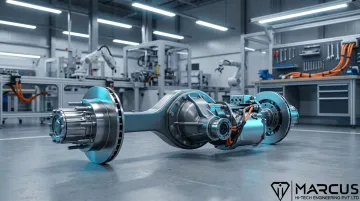
AAM — now operating under the Dauch Corporation umbrella following the acquisition of Dowlais/GKN in February 2026 — designs and manufactures driveline, metal-forming, and powertrain components. US operations span Michigan, Ohio, and Indiana across more than 75 global facilities. Its 2023 Stellantis e-Beam axle award is direct evidence of active EV program participation.
AAM's precision metal expertise under high-load conditions makes it particularly relevant for truck, SUV, and electric drive applications where dimensional tolerance and long-term reliability are non-negotiable.
| Attribute | Detail |
|---|---|
| Key Capabilities | Driveline systems, electric drive units, e-Beam axles, metal forming, powertrain components |
| Certifications | ISO 9001:2015 and IATF 16949:2016 confirmed at quality system level (2025 sustainability report) |
| Best For | OEMs sourcing driveline, axle, or electric drive components for truck, SUV, and EV platforms |
7. Kimball Electronics
Kimball Electronics is an Indiana-based contract manufacturer with a verified IATF 16949-certified automotive facility in Jasper, Indiana. Its automotive product scope includes electronic power-steering control modules, wheel and access sensors, passenger restraint systems, EV charging systems, and cameras.
For OEMs prioritising domestic electronics manufacturing with verifiable site-level certification, Kimball's Jasper facility represents a reliable, auditable option.
| Attribute | Detail |
|---|---|
| Key Capabilities | Power-steering modules, automotive sensors, safety electronics, EV charging systems, cameras |
| Certifications | IATF 16949 confirmed at Jasper, IN; other US sites not verified as automotive-certified |
| Best For | OEMs sourcing automotive safety and control electronics from a certified domestic US manufacturer |
8. Zetwerk
Zetwerk is a global manufacturing platform with die casting, CNC machining, forging, and sheet metal capabilities, and a growing US logistics presence including warehouses in Houston, Los Angeles, Morrisville, Kent, and Wapato. It claims IATF 16949:2016 credentials on its quality page, though certificate-to-facility mapping is not fully disclosed.
Zetwerk's model suits OEMs managing cost pressure — production occurs in lower-cost geographies, with US-side inventory and quality inspection supporting domestic delivery expectations.
| Attribute | Detail |
|---|---|
| Key Capabilities | Die casting, CNC machining, forging, sheet metal — distributed manufacturing with US warehousing |
| Certifications | IATF 16949:2016 claimed at group level; verify site-specific certificates before qualification |
| Best For | OEMs balancing cost competitiveness with US-accessible inventory and delivery |
9. Gestamp
Gestamp specialises in metal components and body-in-white structures, with US operations including Chattanooga facilities and other centres. Its Chattanooga II plant holds a verified IATF 16949:2016 certificate (without product design scope). Gestamp's capability portfolio covers hot stamping, BIW structural components, chassis products, and EV battery boxes.
Hot stamping expertise makes Gestamp particularly relevant for OEMs developing lightweight vehicle architectures — especially EV platforms where structural weight directly affects range.
| Attribute | Detail |
|---|---|
| Key Capabilities | Hot stamping, BIW structures, chassis components, EV battery boxes |
| Certifications | IATF 16949:2016 confirmed at Chattanooga II (without product design scope) |
| Best For | OEMs requiring hot-stamped structural and chassis components for lightweight or EV platforms |
10. Autokiniton (formerly Tower International)
Autokiniton completed its acquisition of Tower International in September 2019. Its US manufacturing capabilities cover hot and cold stamping, welded assemblies, roll forming, tubular products, and high-strength structural components across multiple US plant locations.
Autokiniton's domestic manufacturing base and established OEM relationships make it a practical shortlist candidate for structural body and chassis components where supply chain proximity matters.
| Attribute | Detail |
|---|---|
| Key Capabilities | Hot/cold stamping, welded assemblies, roll forming, tubular products, high-strength structural components |
| Certifications | OEM-specific approvals and facility-level IATF certificates — verify directly before qualification |
| Best For | OEMs prioritising US-domestic structural stamping and body assembly supply |
How We Chose the Best Automotive Contract Manufacturers
IATF 16949:2016 was treated as a baseline, not a differentiator. Any manufacturer without it was excluded from consideration. The more important evaluation question is whether IATF certification exists at the specific facility and scope relevant to your program — not just at a corporate level.
Shortlisting based on capability brochures and unit price quotes — without verifying automotive-specific process compliance — is where programs get into trouble. A manufacturer unable to support APQP, PPAP, and FMEA integration introduces real risk into launch timelines and certification submissions.
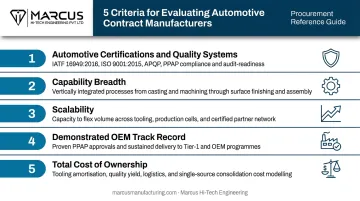
The five criteria applied:
- Automotive certifications and quality systems — IATF 16949 confirmed at the relevant facility and scope, with awareness of OEM-specific customer-specific requirements (CSRs)
- Capability breadth — processes that map directly to the vehicle program's bill of materials, not just headline manufacturing claims
- Scalability — ability to ramp from prototype through full production volumes across a model lifecycle
- Demonstrated OEM track record — verifiable evidence at the site level: named programs, named customers, or auditable production history
- Total cost of ownership — tooling investment, logistics costs, and lead times factored in, not just piece price
For globally sourced programs, DFM review participation, FAIR submission capability, and inline inspection access matter as much as raw production capacity. According to MEMA research, 79% of suppliers in 2023 expressed concern about sub-tier financial viability. Supply chain transparency and financial stability belong on every shortlist evaluation checklist.
Conclusion
The right automotive contract manufacturing partner meets IATF 16949 quality standards, supports your engineering process from DFM through PPAP, and can scale with your production demands. Company size and brand recognition are not sufficient selection criteria — what matters is verified, facility-level compliance and demonstrated program experience.
Before awarding a long-term contract, procurement and supply chain leads should audit shortlisted manufacturers for Cpk levels, CMM access, tooling design capability, financial stability, and sub-tier supply chain transparency.
Those criteria are where Marcus Hi-Tech Engineering stands out as a global sourcing alternative for US automotive OEMs. Marcus is an India-based, IATF 16949:2016 certified manufacturer with 45+ years of automotive production experience — covering die-cast components, precision-machined parts, and electro-mechanical assemblies under one roof, with direct-to-warehouse shipping to the US. Contact the Marcus team to discuss your program requirements.
Frequently Asked Questions
Do OEMs use contract manufacturers?
Yes — most automotive OEMs routinely outsource component production, subassemblies, and in some cases complete vehicle assembly to contract manufacturers. The primary drivers are cost efficiency, access to specialised process capability, and production capacity flexibility.
Is a contract manufacturer an OEM?
No. A contract manufacturer produces goods to another company's specifications and design, while an OEM owns the product design and brand. A contract manufacturer may supply OEMs but does not itself hold the OEM designation unless it sells products directly under its own brand.
What certifications should an automotive contract manufacturer have?
IATF 16949:2016 is the primary quality management standard for automotive manufacturing. Supplementary credentials to verify include ISO 9001, process compliance with AIAG Core Tools (APQP, PPAP, FMEA, MSA, SPC), and any OEM customer-specific requirements (CSRs).
What is the difference between a Tier 1 supplier and a contract manufacturer in automotive?
A Tier 1 supplier typically sells finished systems or modules directly to an OEM under their own brand and supply agreement. A contract manufacturer builds to the OEM's or Tier 1's design without owning the product IP. In practice, some companies — including several on this list — operate in both capacities simultaneously.
What types of components do automotive contract manufacturers typically produce?
Common categories include die-cast and machined structural or powertrain components, stamped metal body parts, injection-moulded plastics, wire harnesses, PCBAs, ECUs, and electro-mechanical assemblies.
How do I evaluate an automotive contract manufacturer for quality and on-time delivery?
Request IATF 16949 certificates with valid facility scope, review PPAP submission track records, and ask for OEE and on-time delivery KPIs. Before awarding a contract, conduct an on-site audit covering CMM access, inline inspection systems, and tooling capabilities.