Introduction
Demand for aluminium die casting in the USA is accelerating fast. Automotive lightweighting mandates, EV battery enclosure production, aerospace procurement, and industrial automation are all pushing manufacturers toward high-pressure aluminium casting at scale. Choosing the wrong supplier means missed tolerances, delayed programs, and costly re-sourcing.
Aluminium die casting delivers what engineers need most: complex geometries, tight tolerances, high-volume repeatability, and a strength-to-weight ratio that zinc and magnesium simply cannot match for most structural applications. But with dozens of suppliers claiming similar capabilities, procurement and engineering teams need a cleaner way to evaluate who actually delivers.
This guide covers the top 10 aluminium die casting companies operating in or serving the USA, the criteria used to evaluate them, and what to look for when choosing the right manufacturing partner.
Key Takeaways
- The US aluminium casting market was valued at $13.76 billion in 2025, with die casting accounting for 80.56% of revenue
- Evaluate suppliers on machine tonnage range, IATF 16949/ISO 9001 certification, industry focus, and post-casting capabilities
- Certifications like IATF 16949 and processes like PPAP/APQP directly reduce OEM qualification risk
- End-to-end suppliers (DFM → tooling → casting → machining → assembly) shorten lead times and reduce supply chain complexity
- Globally certified manufacturers serving North America deliver equivalent quality at lower cost — without compromising on OEM-grade standards
Overview of Aluminium Die Casting in the USA Market
Aluminium die casting is a high-pressure metal forming process: molten aluminium is injected into precision steel dies under pressures reaching thousands of PSI, producing complex, dimensionally stable parts at high volumes.
Compared to zinc or magnesium, aluminium offers a superior strength-to-weight ratio, excellent corrosion resistance, and better thermal conductivity — making it the preferred material for structural automotive components, electronics housings, and EV thermal management parts.
According to Grand View Research, the US aluminium casting market reached $13.76 billion in 2025 and is forecast to grow at 5.1% CAGR through 2033, reaching $20.28 billion. Die casting represents 80.56% of that revenue — implying a die casting component of approximately $11 billion, an editorial estimate, not a separately reported figure.
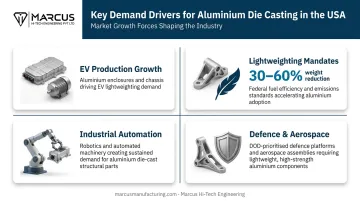
Key demand drivers include:
- EV production growth: battery enclosures, motor housings, and structural chassis components
- Lightweighting mandates: the US Department of Energy estimates aluminium can reduce component weight by 30–60%
- Industrial automation, including robotics and precision machinery requiring complex cast housings
- Defence and aerospace: castings identified as a defence-industrial-base priority by the DOD
With that market context in mind, the ten companies below were selected based on aluminium-specific manufacturing capability, machine tonnage range, certifications, post-casting services, and industry reach — giving you a practical starting point for supplier evaluation.
Top 10 Aluminium Die Casting Companies in the USA
Companies are listed in no particular ranking order.
Gibbs Die Casting Group
Founded in 1965 and headquartered in Henderson, Kentucky, Gibbs Die Casting Group is one of North America's largest high-pressure aluminium die casting manufacturers. The company specialises in safety-critical and structural automotive components — transmission cases, engine brackets, and EV housings — with deep OEM relationships and large-format structural casting expertise.
| Detail | Information |
|---|---|
| Founded / HQ | 1965 / Henderson, Kentucky, USA |
| Key Industries | Automotive, Electric Vehicles, Structural Components |
| Capabilities | High-pressure aluminium die casting, thin-wall structural castings, CNC machining, multi-country facilities |
Ryobi Die Casting
A subsidiary of Japan's Ryobi Group (founded 1943), Ryobi Die Casting operates a major US facility in Shelbyville, Indiana. The company focuses on complex structural aluminium castings for automotive customers, with in-house die design, process engineering, and high-volume production capability backed by disciplined process controls inherited from its Japanese parent group.
| Detail | Information |
|---|---|
| Founded / HQ | Ryobi Group 1943 / Shelbyville, Indiana, USA |
| Key Industries | Automotive, Structural Components |
| Capabilities | Aluminium die casting, in-house die design, process engineering, high-volume production |
Pace Industries
Founded in 1970 in Harrison, Arkansas, Pace Industries has grown into one of North America's largest die casting networks, with 18 US and Mexico facilities and its global headquarters now in Novi, Michigan. The company handles aluminium, zinc, and magnesium programmes with full engineering, tooling, machining, and assembly support.
| Detail | Information |
|---|---|
| Founded / HQ | 1970 / Novi, Michigan, USA (global HQ) |
| Key Industries | Automotive, Medical, Electrical, Industrial |
| Capabilities | Aluminium, zinc, magnesium die casting; tooling; CNC machining; assembly; 18-plant network |
Dynacast
Part of Form Technologies, Dynacast operates multiple US production sites and differentiates through proprietary multi-slide die casting technology. This process uses several moving slides to form small, complex geometries with tight dimensional repeatability across high-volume runs. Dynacast serves automotive, electronics, healthcare, and consumer sectors.
| Detail | Information |
|---|---|
| Founded / HQ | Part of Form Technologies / Multiple US locations |
| Key Industries | Automotive, Electronics, Healthcare, Consumer Products |
| Capabilities | Precision aluminium die casting, multi-slide technology, real-time process monitoring, global sites |
Shiloh Industries
Now part of MiddleGround Capital's portfolio following a 2020 acquisition, Shiloh Industries focuses on high-pressure and vacuum-assisted structural aluminium and magnesium die castings for vehicle OEMs and Tier 1 suppliers. Its vacuum-assisted process reduces internal porosity — particularly relevant for structural chassis and body-in-white components.
| Detail | Information |
|---|---|
| Founded / HQ | USA (multiple locations) |
| Key Industries | Automotive, Commercial Vehicles |
| Capabilities | High-pressure and vacuum aluminium die casting, magnesium die casting, structural components, stamping |
Apex Aluminum Die Casting Company
Family-owned in Piqua, Ohio since 1980, Apex operates 14 custom-built manual and automated die cast machines — each with its own dedicated furnace. This setup supports low-to-mid volume production where varied tooling requirements and shorter run lengths demand careful process management — without the constraints of shared furnace scheduling.
| Detail | Information |
|---|---|
| Founded / HQ | 1980 / Piqua, Ohio, USA |
| Key Industries | Industrial, Consumer Products, General Manufacturing |
| Capabilities | Aluminium die casting (low to mid volume), 14 dedicated machines with furnaces, zinc die casting |
Empire Die Casting
With roots dating to 1947 and a 200,000 sq ft facility in Macedonia, Ohio, Empire Die Casting operates aluminium machines in the 400–1,200T range and serves a diverse industry mix — medical, automotive, locomotive, oil and gas. That breadth is its differentiator: Empire handles varied production demands across tonnage levels under one roof with integrated machining services.
| Detail | Information |
|---|---|
| Founded / HQ | Roots dating to 1947 / Macedonia, Ohio, USA |
| Key Industries | Medical, Automotive, Oil & Gas, Locomotive |
| Capabilities | Aluminium die casting, 400–1,200T machines, 200,000 sq ft facility, CNC machining |
Aluminum Die Casting Company (ADC)
Founded in 1950 and operating from a 35,000 sq ft plant in Mira Loma, California, ADC offers a full-service model that includes billet CNC machining, mechanical assembly, plating, powder coating, and wet painting. Its expedited tooling turnaround and one-stop finishing capability reduce handoffs and lead times for West Coast industrial and consumer product manufacturers.
| Detail | Information |
|---|---|
| Founded / HQ | 1950 / Mira Loma, California, USA |
| Key Industries | Industrial, Consumer Products, Electronics |
| Capabilities | Aluminium die casting, CNC machining, assembly, plating, powder coating, wet painting |
Cascade Die Casting Group
Founded in 1978 by Ted Hohman, Cascade Die Casting Group is a privately held manufacturer producing aluminium and zinc die castings for automotive, appliances, consumer goods, electronics, and transportation OEMs. All facilities hold IATF 16949 certification, and the company's multi-market experience gives it strong alloy expertise across application types.
| Detail | Information |
|---|---|
| Founded / HQ | 1978 / USA (multiple locations) |
| Key Industries | Automotive, Appliances, Consumer Goods, Electronics, Transportation |
| Capabilities | Aluminium and zinc die casting, multi-sector OEM supply, high-volume production |
Modern Aluminum Castings
Established in 1919 and based in Terre Haute, Indiana, Modern Aluminum Castings Co. has over a century of foundry experience behind it. The company offers both die casting and sand casting through a design-to-delivery collaboration model, with around-the-clock client support — including weekends — for programmes that require tight turnarounds or hands-on development work.
| Detail | Information |
|---|---|
| Founded / HQ | 1919 / Terre Haute, Indiana, USA |
| Key Industries | Industrial, Automotive, General Manufacturing |
| Capabilities | Aluminium die casting, sand casting, design collaboration, complex and urgent casting support |
How to Choose the Right Aluminium Die Casting Partner
The Evaluation Framework
Most procurement teams evaluate die casting suppliers on price first. That's the wrong starting point — and it leads to costly qualification failures, scrap rate surprises, and delayed production launches.
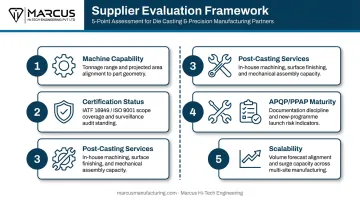
A more reliable evaluation framework covers five areas:
- Aluminium-specific machine capability — confirm the tonnage window and whether it fits your part's projected area and cavity pressure requirements (NADCA defines tonnage as clamp force, not part weight)
- Certification status — IATF 16949:2016 is required for automotive supply chain qualification; ISO 9001 is the baseline for general quality management. Always verify at the plant level, not just group level
- Post-casting services — CNC machining, assembly, and surface finishing in-house means fewer handoffs, tighter tolerance control, and shorter overall program timelines
- APQP/PPAP process maturity — AIAG's APQP and PPAP frameworks reduce launch risk and give OEM procurement teams the documentation they need for sign-off
- Scalability — a supplier that can handle your current volume but not your year-3 forecast is a transition risk, not a long-term partner
What to Look for Beyond the Profile
When you go beyond a supplier's marketing page, look at:
- Reject rates and PPM history — ask for customer-facing PPM data, not just internal scrap percentages
- PPAP compliance record — how often do first submissions pass, and how quickly are deviations resolved?
- Lead time consistency — on-time delivery performance over 12 months tells you more than a quoted lead time
- Tool ownership terms — understand who owns the die and what happens at end of contract
These criteria apply whether you're sourcing domestically or from globally certified manufacturers. Marcus Hi-Tech Engineering, for example, holds IATF 16949:2016 and ISO 9001 certifications and runs cold chamber aluminium die casting from 60T to 2,500T — with in-house tooling, CNC machining, surface finishing, and assembly — making it a viable single-source option for North American OEMs and Tier 1 suppliers evaluating offshore consolidation.
Conclusion
Choosing an aluminium die casting partner comes down to alignment: machine capacity that matches your part requirements, quality systems that satisfy your OEM's qualification process, post-casting capabilities that reduce your supplier count, and a scalability path that supports your growth.
Go beyond the company profile. The suppliers worth shortlisting are the ones who can answer clearly on:
- Reject rates and first-pass yield history
- PPAP completion records and OEM qualification experience
- Lead time performance across production and tooling phases
- Whether their engineering team engages early enough to add meaningful DFM input
Those are the factors that determine whether a partnership delivers or disappoints.
If your evaluation points toward a globally certified partner with deep vertical integration, Marcus Hi-Tech Engineering covers the full scope — die casting, CNC machining, in-house tooling, surface finishing, and assembly — for North American customers, with direct-to-warehouse shipping and IATF 16949:2016 certification. Get in touch to discuss your program requirements.
Frequently Asked Questions
What is aluminium die casting used for in the USA?
Aluminium die casting is used across automotive (transmission cases, engine brackets, suspension parts), EV (battery enclosures, motor housings), aerospace, electronics, and industrial machinery applications. The material is favoured for its strength-to-weight ratio, corrosion resistance, and dimensional consistency at high production volumes.
What certifications should I look for in an aluminium die casting supplier?
IATF 16949:2016 is the standard for automotive supply chains; ISO 9001 serves as the baseline for non-automotive sectors. APQP, PPAP, and FAIR provide further assurance of production readiness. Always verify certifications at the specific plant, not just at the group level.
What machine tonnage range is needed for aluminium die casting projects?
Tonnage depends on part size, projected area, and cavity pressure — not part weight alone. Smaller precision components typically require 40–200T machines, mid-range structural parts require 400–1,000T, and large automotive or EV structural castings can require 1,500T and above. Always request a projected-area calculation from your supplier rather than relying on a generic tonnage-to-part-size table.
How do I evaluate the quality capability of an aluminium die casting company?
Look for IATF 16949 and ISO 9001 certification (verified at plant level), inline inspection, CMM metrology, documented PPAP and APQP processes, and traceability systems. To go beyond surface claims, request customer PPM data, gauge R&R studies, and corrective action closure rates.
Can US companies source aluminium die castings from overseas manufacturers?
Yes. Many US OEMs and Tier 1 suppliers source from IATF 16949:2016-certified manufacturers in India, Vietnam, and Mexico, where quality is maintained at lower unit cost. Evaluate total landed cost including freight, tariffs, inventory carrying costs, and FX exposure, not unit price alone.
What is a typical lead time for aluminium die casting parts?
Tooling lead times vary by supplier. Marcus Hi-Tech Engineering, for example, quotes 4–6 weeks for die development with FAIR completion within one additional week. Production lead times for repeat orders depend on volume and complexity; suppliers with in-house machining and finishing can compress overall timelines significantly.